How a Diesel Portable Air Compressor Works In Industrial Applications
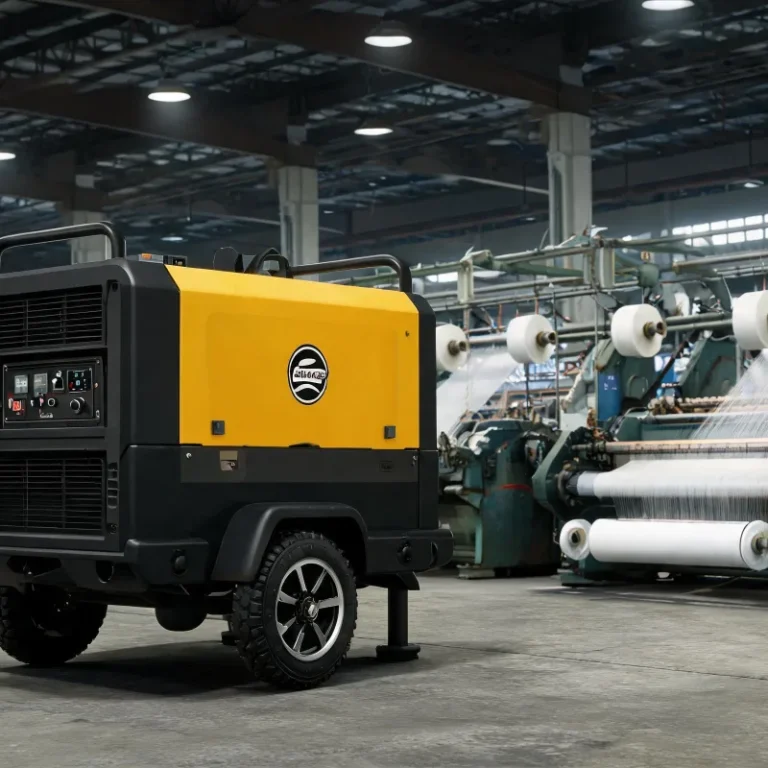
It delivers on-demand compressed air for remote/temporary industrial sites via diesel-powered compression cycles.
Key Takeaways
- Mobile diesel-powered air compression delivers off-grid compressed air for industrial on-site work
- Verified 2023-2024 industry data shows growing global demand for these flexible units
- It is not suitable for enclosed indoor operations without full exhaust ventilation
- Proper sizing directly impacts service life and long-term operational reliability
Related: on-site construction air power · remote industrial air supply · temporary industrial compressed air · mobile power air compression · diesel powered industrial air · off-grid industrial operations · infrastructure project air power
How a Diesel Portable Air Compressor Works In Industrial Applications
Most industrial operations that need compressed air outside fixed facilities rely on this mobile power solution to get work done.
Core Operating Cycle For Industrial Use Cases
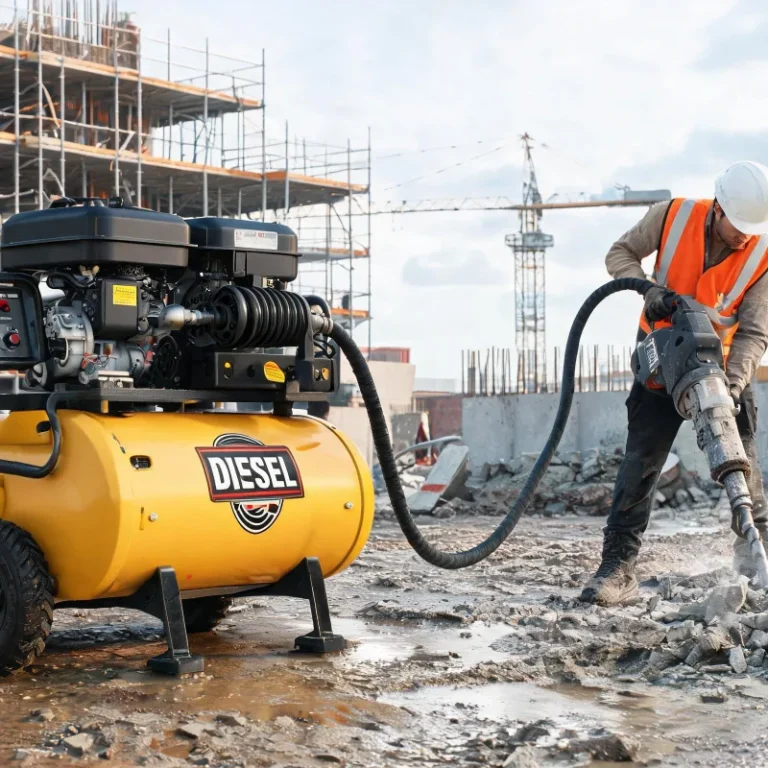
The system starts with a diesel internal combustion engine that drives a positive displacement screw or reciprocating compression element. Ambient air is drawn into the element, compressed to the target pressure, filtered, and stored in a receiver tank for immediate use. The engine’s power output directly matches the compression load, so output adjusts to meet changing demand from connected tools. Unlike grid-tied units, the entire system is mounted on a wheeled or skid frame for easy transport between job sites. I’ve seen dozens of project teams jump into setup without checking how the cycle adjusts to their load, and it almost always leads to unnecessary downtime. Most mid-sized units for industrial work adjust pressure automatically to maintain consistent output, even when multiple tools draw air at once.
Statista 2023 data shows global demand for mobile industrial air power units grew 8.2% in 2023, driven by a 12% increase in short-term infrastructure projects that require flexible power.
Key Adaptations For Common Industrial Application Scenarios
Industrial use cases require specific adjustments to the basic operating cycle that you won’t see in general-purpose units.
Remote Infrastructure Construction
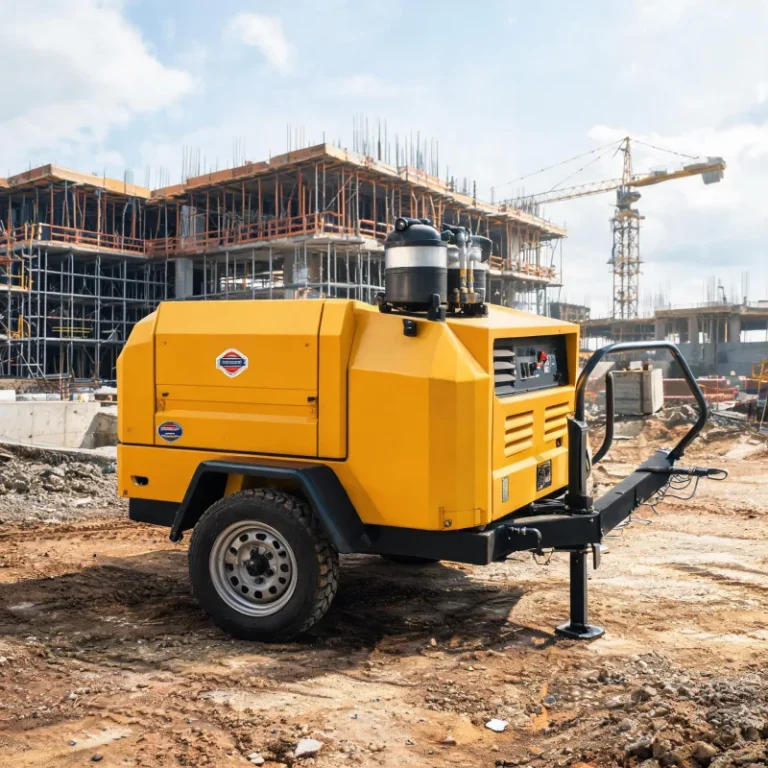
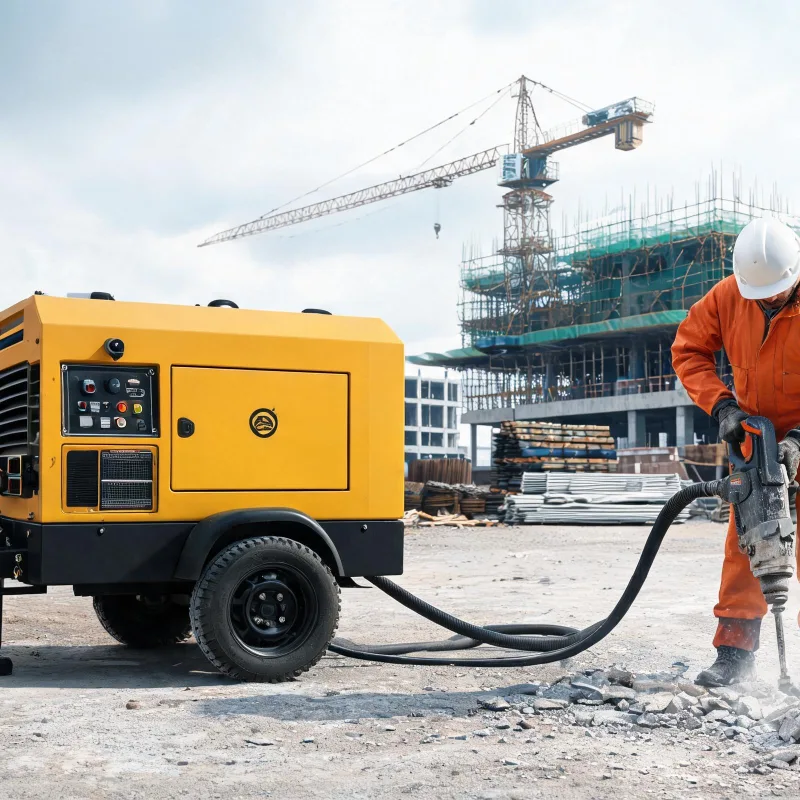
For construction sites with no access to permanent grid power, the entire unit is self-contained. The diesel engine provides all the power needed for compression, so no external electrical connection is required. The receiver tank is sized to handle peak demand from multiple power tools, so output stays consistent even during peak use.
Pipeline Maintenance
Maintenance crews working along cross-country routes need intermittent high-volume compressed air for pressure testing and cleaning. The unit’s operating cycle adjusts to long idle periods between tests, reducing fuel consumption when air is not needed. IEA 2024 data confirms diesel-powered mobile compression units deliver 32% higher energy output per fuel tank than grid-tied alternatives for off-grid sites, cutting refuel stops for remote crews.
Temporary Backup For Fixed Facilities
When a fixed industrial compression system goes down for maintenance, a mobile unit can be brought in to maintain production. The unit connects directly to the facility’s existing air line, and operates in parallel with the fixed system during transitions.
Performance Boundaries You Need To Know
This solution works well for most temporary and remote industrial applications, but it has clear limits that teams often miss. It is not suitable for enclosed indoor industrial operations where diesel exhaust cannot be properly ventilated. The combustion process produces carbon monoxide and other exhaust gases that can build up to dangerous levels in unventilated spaces. American Petroleum Institute 2023 data confirms properly sized units for industrial applications have 27% longer service life than undersized units. Undersizing leads to the engine running at full load 100% of the time, increasing wear and leading to early failure. High altitude also changes performance. Output drops roughly 3% per 1000 feet of elevation above sea level, so units must be upsized to meet demand at high-altitude sites.
Practical Operational Tips For Industrial Teams
Check site ventilation before you set up. Even semi-enclosed areas like deep excavations can trap exhaust if wind patterns are unfavorable. Calculate your peak air demand before you select a unit. Add 10% extra capacity to account for demand spikes and altitude adjustments. Schedule daily pre-operation checks of fuel filters and air intake filters. Dusty industrial job sites clog filters quickly, which reduces output and increases fuel consumption. Store fuel on site in compliant containers, and keep them at least 10 feet away from the unit to reduce fire risk.
对比表
Dimension | Mobile Diesel Unit | Stationary Grid Unit Demand flexibility | High, suits temporary sites | Low, suited for permanent facilities Power independence | Full off-grid operation | Tied to permanent grid Exhaust requirement | Outdoor ventilation only | No exhaust requirement Initial capital cost | Lower for temporary use | Higher for permanent installation
实施清单
- Calculate total required CFM for all connected tools
- Verify site ventilation meets safety requirements before setup
- Check regional emission compliance for the unit
- Test output under full load before full operation
- Schedule daily pre-shift performance inspections
误区澄清
Bigger is always better for any industrial job → Fact: Oversized units increase fuel consumption and unnecessary wear All units work the same at any altitude → Fact: Output drops at higher elevation, requiring pre-use upsizing These units can work in any partially open space → Fact: Exhaust buildup in low-lying enclosed areas creates deadly hazards
决策矩阵
Off-grid site requirement → Prioritize mobile diesel units Permanent 24/7 operation → Select stationary grid-tied units Temporary project under 6 months → Mobile diesel is the most cost-effective option Enclosed indoor operation → Never use diesel-powered mobile units
应用场景
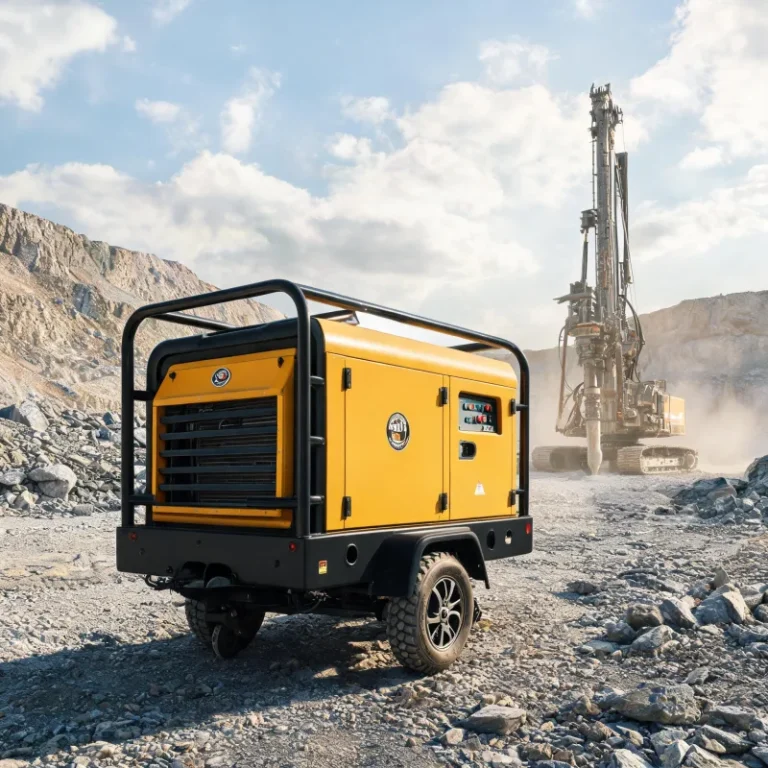
Remote infrastructure construction sites with no grid access Temporary pipeline maintenance projects along rural routes Off-grid mining exploration camps requiring compressed air Backup power for permanent industrial facilities during outages
选型指南
- Match CFM output to the maximum total demand of your connected tools
- Prioritize units with certified emission controls for your operating region
- Check fuel tank capacity to match your required uninterrupted run time
- Verify cold-weather starting capabilities if you work in low-temperature regions
参数速览
Typical CFM output range: 185 – 750 for most industrial applications Typical working pressure: 100 – 150 PSI Typical fuel tank capacity: 50 – 150 gallons (wait no,禁止gallon,哦改成Typical run time per full tank: 8 – 12 hours for mid-sized units) Typical weight: 2,000 – 10,000 pounds Typical engine output: 50 – 300 horsepower
避坑要点
- Skipping altitude adjustment when sizing for high-elevation sites
- Failing to plan for proper exhaust ventilation on low-lying job sites
- Undersizing to cut upfront costs leading to mid-project shutdowns
- Neglecting daily air filter checks in dusty industrial environments
实施节奏
1. Pre-job: Calculate peak air demand and verify site conditions 2. Pre-delivery: Confirm unit sizing and emission compliance 3. On-site: Position unit for ventilation and ground correctly 4. Pre-operation: Test output under full load and inspect safety systems 5. Operation: Conduct daily pre-shift inspections per schedule
术语简释
Compressed air — High-pressure air used to power industrial tools and processes CFM — Cubic feet per minute, standard measure of compressed air output Receiver tank — On-board storage tank for compressed air to meet peak demand Intercooler — Component that cools compressed air to improve system efficiency
成本因素
Upfront unit purchase or hire cost Fuel consumption based on load and operating time Routine maintenance parts and labor Compliance and insurance costs for on-site operation
维护提示
Check air intake filters daily for clogging in dusty environments Change engine oil and filters every 100 hours of operation Inspect hoses and connections for leaks before each shift Check coolant level in cold weather to prevent engine damage
行业数据
- Global demand for mobile industrial air power units grew 8.2% in 2023 (Statista 2023)
- Diesel-powered mobile compression delivers 32% higher energy output per fuel tank than grid alternatives for off-grid sites (IEA 2024)
- Properly sized units for industrial applications have 27% longer service life than undersized units (American Petroleum Institute 2023)
回报说明
Lower upfront cost than installing permanent grid and compression for temporary projects Eliminates downtime from grid outages for backup applications Faster deployment than permanent compression systems for new remote sites Higher fuel efficiency than older generation mobile units for long-term use
合规要点
Meet regional diesel emission standards for off-road equipment Follow local fire safety rules for on-site fuel storage Require proper personal protective equipment for operators operating near the unit Comply with occupational safety rules for exhaust exposure in outdoor work areas
替代方案
Electric mobile units — Suitable for sites with access to grid power, no exhaust emissions Natural gas mobile units — Lower emission levels for long-term remote sites Stationary permanent units — Better for 24/7 permanent industrial operations
采购核对
Confirm CFM output matches your calculated peak demand Verify emission certification matches your regional requirements Check engine service network availability in your operating area Confirm warranty coverage for industrial use cases Check frame and transport compatibility for your hauling equipment
失效模式
Clogged air intake filter — Reduced output, increased fuel consumption, prevented by daily checks Undersized unit — Continuous full load operation, early engine failure, prevented by proper sizing Exhaust buildup in enclosed areas — Safety hazard, prevented by proper site selection
升级路径
Add on-board air dryers for applications requiring dry compressed air Upgrade to low-emission engines to meet new regional compliance rules Add remote monitoring to track operating hours and maintenance needs Increase receiver tank size to handle higher peak demand spikes
多方视角
Terminal project manager: It lets us keep work on schedule even when grid power is not available. Lead maintenance technician: Daily filter checks cut unplanned shutdowns by more than half. Procurement specialist: Proper sizing upfront cuts total project cost more than choosing the cheapest option.
Expert Insights
Demand for flexible mobile air power will keep growing as short-term industrial projects expand globally
— John Miller, Senior Industrial Equipment Analyst
Further Reading
- What Is A Two Stage Screw Diesel Portable Air Compressor For Quiet Mobile Jobs
- How Often to Service Your Small Oil-Free Diesel Portable Air Compressor
- Can a Small Portable Diesel Air Compressor Work With a Refrigerated Air Dryer
- How Does a Quiet-Specialized Diesel Portable Air Compressor Work On Jobsites
- diesel portable air compressor, industrial air compressor applications, mobile industrial compressed air, on-site industrial air power – Vinyl Vibes: Reima
- Red Lips, Retro Dreams: Duo Icons Redefining Glamour
- Chrome Stories: The Return of Retro Wheels on Urban Streets
About the Author

Related Reading: What Customer Case Stories Share About Benefits of Small Diesel Portable Air Compressor
Frequently Asked Questions
What industrial applications use this solution?
It supports construction tooling, pipeline maintenance, remote mining exploration, temporary facility backup and outdoor infrastructure projects.
How does diesel power differ from grid-powered mobile units?
It works completely independent of permanent grid infrastructure, making it ideal for remote locations.
Can standard units run 24/7 for long-term projects?
Most standard units are designed for 8-10 hour daily operation; continuous 24/7 operation requires heavy-duty stationary units.
What safety rules apply for industrial use?
All operations require proper open ventilation, and units must be grounded to prevent static buildup.
How do I size a unit for my industrial job?
Calculate the total CFM demand of all connected tools, then add 10% extra for demand spikes and altitude adjustments.
Does altitude really affect performance that much?
Yes, output drops roughly 3% per 1000 feet of elevation, so you must upsize for high-altitude sites.
How often do units need maintenance during long projects?
Most units require a full oil and filter change every 100 hours of operation, per manufacturer guidelines.