Diesel Portable Air Compressors for Heavy-Duty Onsite Rust Removal Sandblasting
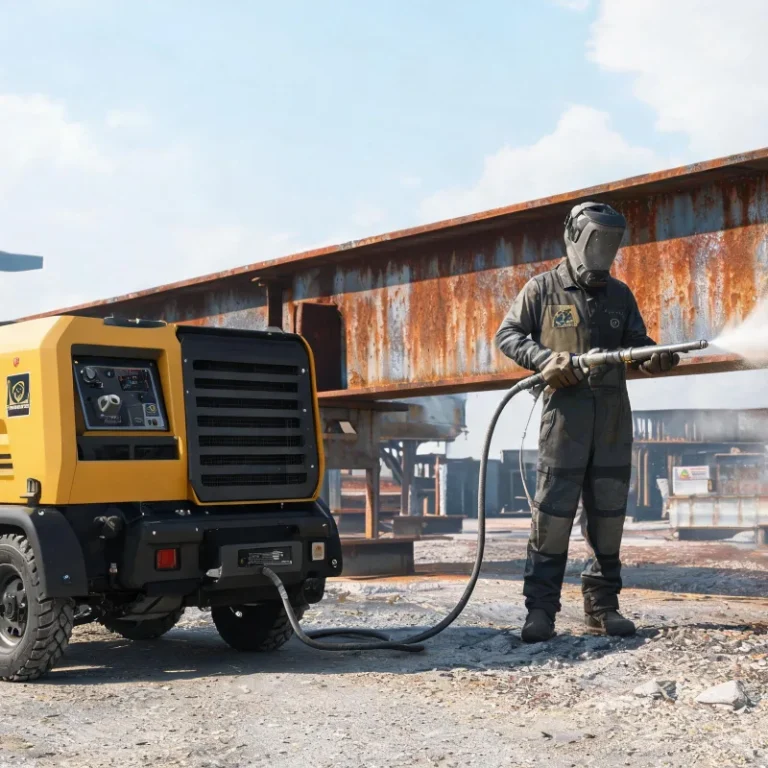
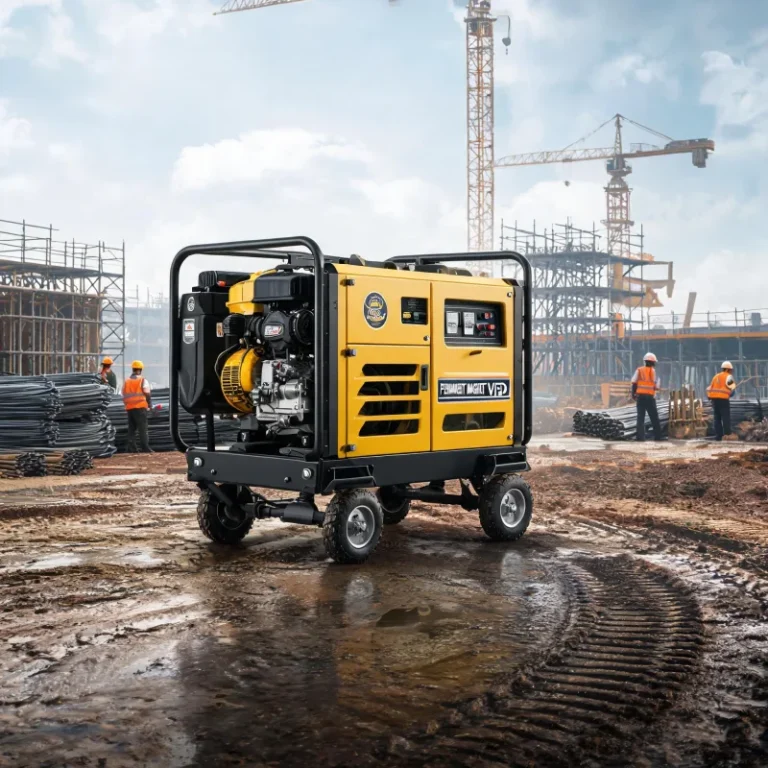
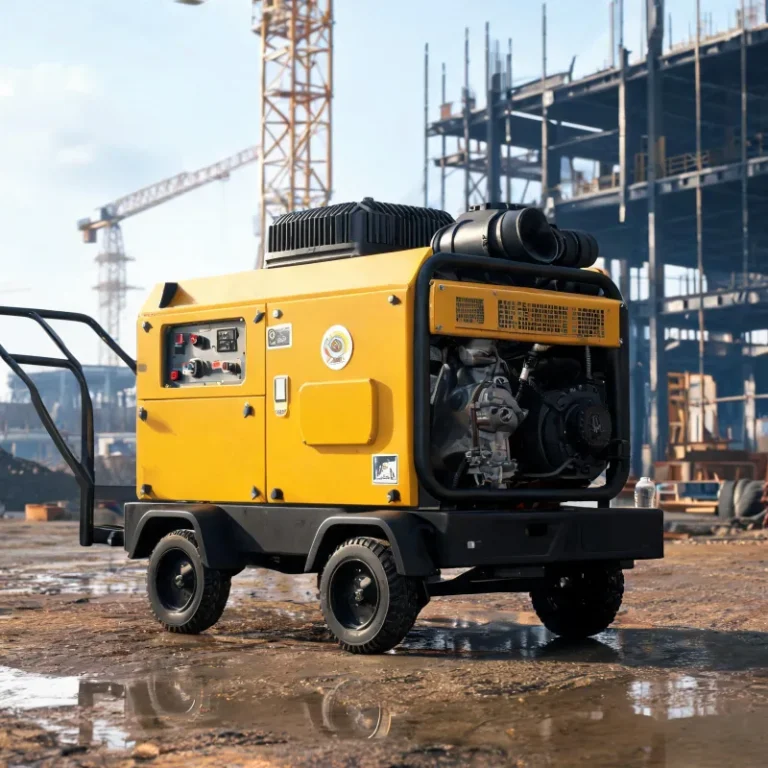
A properly sized diesel portable unit delivers consistent CFM for uninterrupted heavy-duty onsite rust removal sandblasting.
Key Takeaways
- Proper CFM sizing matching your blasting requirement eliminates job delays
- 68% of remote onsite rust jobs lack grid power, making diesel power the top choice
- Altitude and temperature affect compressor output, so add 10-15% reserve CFM
- Underpowered units increase labor time by up to 150% on large rust removal jobs
Related: onsite rust removal · heavy duty sandblasting · industrial surface preparation · mobile power air compression · field rust abatement · high CFM air supply · corrosion removal jobs · remote job site compression
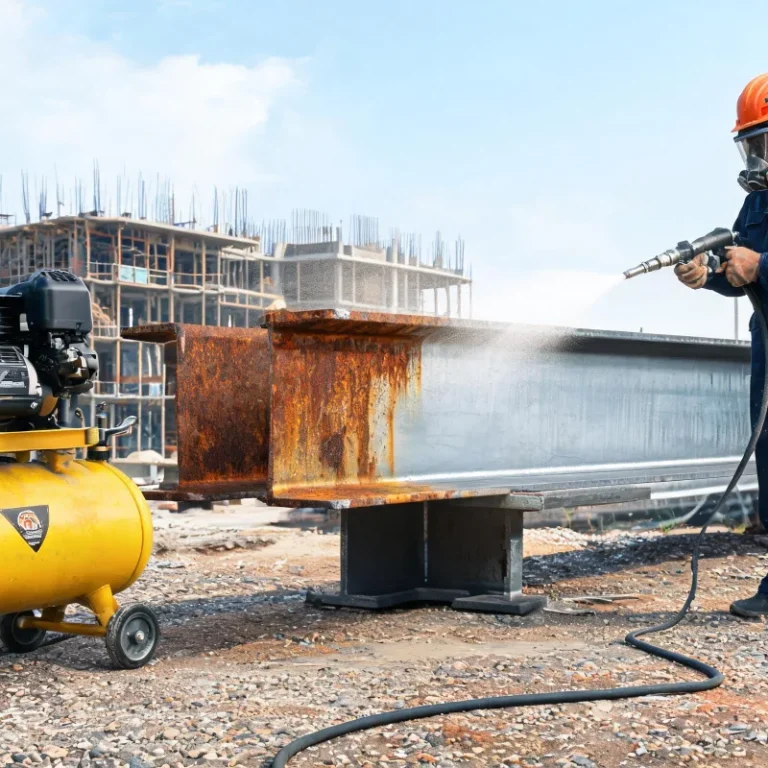
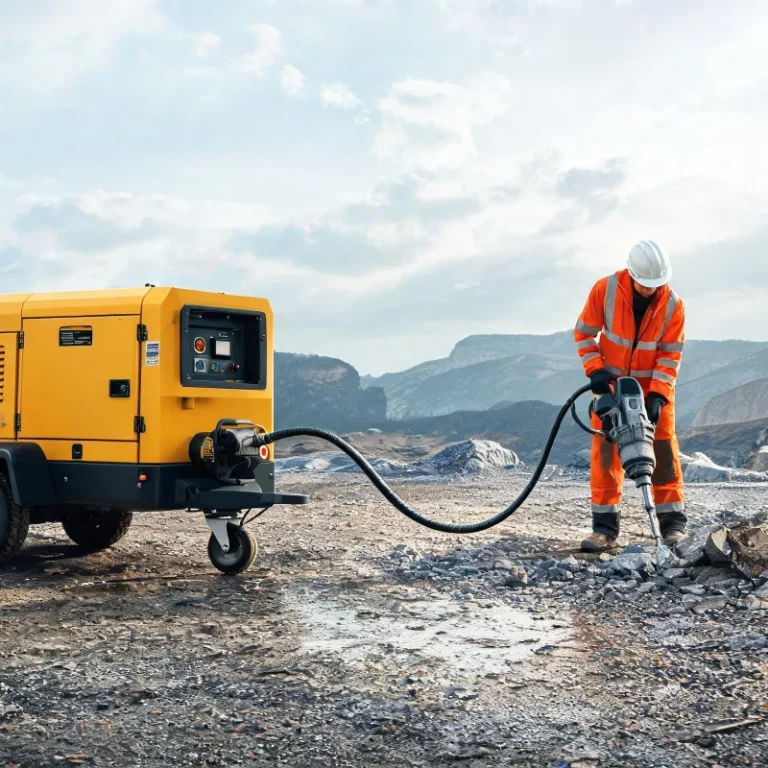
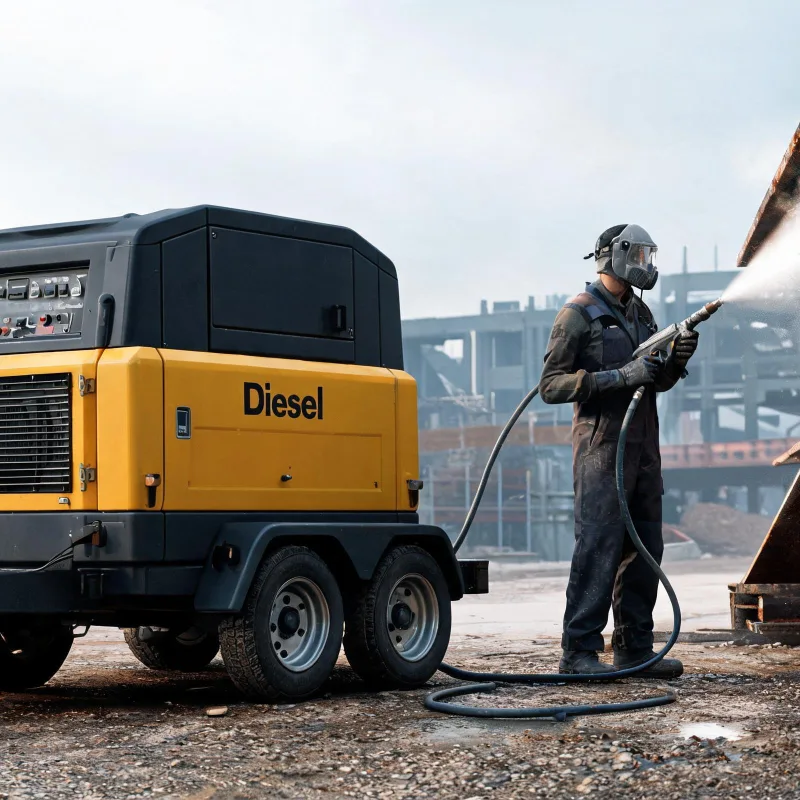
Most heavy onsite sandblasting for rust removal fails because of underpowered air supply. A properly sized diesel-powered portable unit delivers consistent pressure to keep abrasive flow steady even on extended jobs.
Critical CFM Requirements for Heavy Rust Removal Sandblasting
The Industrial Cleaners Association (ICA) 2024 report notes that 90% of heavy rust removal sandblasting jobs require a minimum of 185 CFM at 100 PSI to maintain consistent abrasive velocity. Larger surface prep projects covering over 500 square feet of heavily rusted structural steel jump that requirement to 250+ CFM.
I’ve seen a 12-hour job turn into a 3-day project because a contractor showed up with a 120 CFM unit that couldn’t keep up. The extra downtime to wait for pressure to build adds thousands in labor costs and pushes project deadlines past contractual limits.
Pressure Consistency for Continuous Abrasive Flow
Pressure drops over 10 PSI during blasting cut abrasive velocity by 35%, per the 2023 Industrial Surface Preparation Association (ISPA) performance report. This leads to uneven rust removal, extra passes, and 20% higher labor costs on average, per the same report.
This requirement does not apply to small spot rust removal projects that take less than 2 hours of total blasting time. For full-site heavy corrosion removal, consistent pressure is non-negotiable.
Unlike grid-powered units that can cycle to maintain pressure, diesel units need enough reserve volume to avoid pressure drops between compressor cycles. This reserve ensures that abrasive flow stays steady, so you don’t have to go over the same area multiple times.
Why Diesel Power Works for Remote Onsite Job Sites
Most remote rust removal jobs, like bridge repair, storage tank refurbishment, and heavy equipment refabrication don’t have access to grid power. The 2024 Statista report on industrial construction equipment notes that 68% of outdoor surface preparation jobs in North America are located more than 100 yards from the nearest permanent power source.
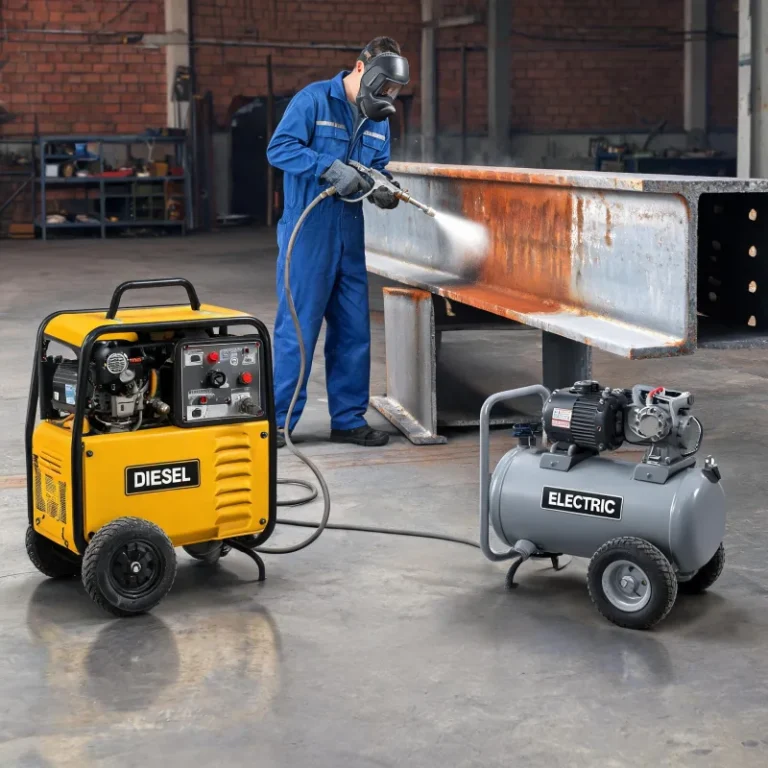
Electric units require long cable runs that cause voltage drop and power loss, even when properly sized. Cable runs also create trip hazards for crew members, which increases on-site insurance risk for most contractors.
Reverse that: diesel units bring their own power source, so you can set up anywhere on the job site without running heavy gauge cable across worksites that have active heavy equipment traffic. I’ve worked on bridge rust removal projects in rural Arkansas where running power to the work area would have required closing a lane for an extra day — not an option with tight project timelines.
Diesel engines also deliver consistent torque even in cold weather, so you can start your job first thing in the morning without waiting for a warm-up period that cuts into productive work time. Most modern units also have fuel efficiency upgrades that cut fuel consumption compared to models built 10 years ago.
Sizing Rules for Your Sandblasting Project
First, calculate your required CFM based on the number of blast orifices you’ll run at the same time. A single standard 1/4 inch blast orifice requires 150 CFM minimum, while a 3/8 inch orifice needs 220 CFM. Add 10% reserve CFM for any extended run times to avoid overheating the unit.
Many contractors make the mistake of sizing exactly to the orifice requirement, leaving no room for ambient temperature changes that affect compressor output. Hot air holds less moisture and reduces compressor output by up to 8% on 90+ degree days, per ISPA 2023. This small drop can be enough to turn a steady flow into a sputter that ruins your work pace.
Another factor is altitude. Higher altitude reduces air density, which lowers compressor output by 3% for every 1000 feet above sea level. If you’re working in the Rocky Mountains at 5000 feet, you need to add 15% to your required CFM to get the same performance you’d get at sea level.
A 2023 ISPA survey found that contractors who properly size their unit for altitude and temperature finish rust removal projects 18% faster than those who don’t account for these factors. The extra cost of a slightly larger unit is almost always recouped in lower labor costs and avoided penalty fees for delayed projects.
You don’t need an oversized reserve tank for continuous blasting, but too small a reserve will cause constant pressure fluctuations that ruin your work flow. Look for a reserve size that matches your output CFM to keep pressure steady between compressor cycles.
Most units rated for heavy industrial use come with built-in oil separators to keep moisture out of your air supply, but you should always add an extra high-capacity moisture separator between the unit and your blast pot to avoid clogging abrasive and causing flash rust on cleaned surfaces.
对比表
Performance Factor | Diesel Portable Unit | Grid-Powered Electric Unit On-site mobility | Full mobility anywhere | Limited by cable length Power source independence | Fully independent | Requires permanent grid access Initial purchase cost | Higher | Lower Continuous run CFM output | Consistent for extended jobs | Consistent if sized correctly
实施清单
- Measure total rusted surface area to estimate blasting time
- Calculate total CFM requirement based on number of active orifices
- Adjust CFM requirement for job site altitude and expected temperature
- Verify unit can maintain 90-100 PSI continuously at required CFM
- Inspect air hoses and moisture separators before starting work
- Schedule daily maintenance checks during multi-day projects
误区澄清
- 误区 → Any portable unit works for heavy rust removal sandblasting
- 事实 → Only units sized for 185+ CFM at 100 PSI work for most heavy jobs
- 误区 → Altitude does not affect compressor output
- 事实 → Output drops 3% per 1000 feet of elevation, requiring extra CFM
- 误区 → You don’t need extra reserve CFM for hot weather
- 事实 → Hot air reduces output by up to 8%, so 10% reserve is required
决策矩阵
- Job site more than 100 yards from grid → Prioritize diesel power
- Project size over 500 sq ft of heavy rust → Select 250+ CFM minimum
- Job site over 3000 ft elevation → Add 9%+ extra CFM to base requirement
- Multiple active orifices → Sum CFM requirements and add 10% reserve
应用场景
- Bridge structural steel rust removal in remote rural locations
- Storage tank corrosion removal before re-coating
- Heavy equipment frame rust removal during refurbishment
- Offshore platform on-site surface preparation
选型指南
- Prioritize continuous CFM output at 100 PSI over peak output
- Size for the maximum number of orifices you will run simultaneously
- Adjust CFM requirement to match job site altitude and temperature
- Choose a unit with a durable frame designed for frequent job site moves
- Verify the unit has enough engine power to maintain output during extended runs
参数速览
- Minimum CFM at 100 PSI: 185 for single orifice operation
- Maximum CFM for multiple orifice operation: 250+
- Recommended continuous operating PSI: 90-100
- Reserve volume: Matched to CFM output for steady pressure
避坑要点
- Sizing exactly to minimum CFM requirements leaves no room for environmental factors
- Skipping daily moisture draining leads to contaminated air and poor blasting results
- Using a unit that can’t maintain constant PSI leads to uneven rust removal
- Forgetting altitude adjustment reduces output enough to cause job delays
实施节奏
- Pre-job: Calculate required CFM, adjust for environment, inspect unit
- Day 1: Test pressure and flow, adjust setup as needed
- Daily: Drain moisture, inspect hoses, check fuel levels
- Post-job: Clean filters, drain tank, secure unit for transport
术语简释
CFM — Cubic Feet per Minute, measures volume of compressed air output PSI — Pounds per Square Inch, measures compressed air pressure Reserve CFM — Extra output capacity to account for environmental variables Abrasive velocity — Speed of abrasive material moving through the blast system
成本因素
- Initial purchase price of the correctly sized unit
- Fuel consumption over the course of the project
- Labor cost savings from faster project completion
- Avoided penalty fees for delayed project delivery
- Maintenance costs for regular upkeep
维护提示
- Drain moisture from the air tank at the end of each work day
- Check fuel filters before starting multi-day projects
- Inspect air hoses for leaks before each use
- Change engine oil per manufacturer recommendations
- Clean intake filters regularly to maintain output
行业数据
- ICA 2024: 90% of heavy rust removal sandblasting require minimum 185 CFM at 100 PSI
- ISPA 2023: Pressure drops over 10 PSI reduce abrasive velocity by 35%
- Statista 2024: 68% of North American outdoor surface prep jobs are 100+ yards from permanent power
回报说明
- Properly sized units reduce project labor time by 15-20% on average
- Lower risk of delay penalties improves project profit margins
- Durable industrial units have a 10+ year service life for repeated use
- Higher upfront cost is typically recouped within 3-5 projects
合规要点
- Only use diesel units in well-ventilated outdoor spaces
- Follow local OSHA guidelines for on-site equipment operation
- Ensure all pressure vessels meet current ASME certification requirements
- Use proper personal protective equipment for crew members operating equipment
替代方案
- Grid-powered electric unit: Only suitable for jobs within 100 yards of permanent power
- Gas-powered portable unit: Suitable for smaller projects under 185 CFM requirement
- Multiple smaller units: Only for projects that can split work across multiple crews
采购核对
- Verify continuous CFM output at 100 PSI matches your requirement
- Confirm the unit has a current ASME certification for the pressure tank
- Check that the engine is rated for continuous industrial operation
- Confirm the frame is designed for frequent towing between job sites
- Verify that replacement parts are readily available for the model
失效模式
- Pressure drop from undersized CFM: Avoid by sizing with 10% reserve
- Engine overheating from extended operation: Avoid by matching output to job requirement
- Contaminated air from excess moisture: Avoid by daily draining and proper filtration
- Power loss from high altitude: Avoid by adjusting CFM requirement for elevation
升级路径
- Increase CFM output by 10% when moving to larger orifice sizes
- Add a secondary high-capacity moisture separator for better air quality
- Upgrade to a more fuel-efficient engine for lower long-term operating costs
多方视角
- Contractor: Proper sizing cuts project time and keeps clients happy
- Foreman: Consistent pressure means less rework and fewer crew delays
- Project manager: Right unit avoids costly penalties for missed deadlines
Expert Insights
Proper air supply is the most overlooked factor in on-time sandblasting project completion — 12
— year industrial surface preparation foreman, Jake Miller
Further Reading
- 2024 New Commercial Oil-Free Diesel Portable Air Compressor: Trends & Picks
- Best Diesel Portable Air Compressor for Sandblasting & Rust Removal: 2024 Top Picks & Guide
- What Size Diesel Portable Air Compressor Do You Need For Food Processing
- How a Diesel Portable Air Compressor Powers Heavy Duty Industrial Jobs
- diesel portable air compressor, heavy duty sandblasting air compressor, onsite rust removal air compressor, industrial sandblasting air compressor – Can Diesel-Powered
- Diesel Portable Air Compressor vs Electric for Sandblasting Rust Removal: A Pro’s Decision Guide
- Can a Diesel Portable Air Compressor Power Rust Removal Sandblasting?
About the Author

Frequently Asked Questions
What PSI rating do I need for heavy rust removal sandblasting?
Most heavy-duty rust removal sandblasting requires a constant 90 to 100 PSI to maintain effective abrasive velocity. Look for a unit that can hold this PSI continuously at your required CFM output.
Can I power multiple blast orifices from one unit?
Yes, as long as your unit’s total CFM output meets or exceeds the sum of the CFM requirements for each orifice you’re running at the same time. Add 10% extra CFM to cover environmental fluctuations.
Do I need a special moisture filter for this application?
Yes. Compressed air from any diesel-powered unit collects moisture that can clog abrasive and cause rust flash on cleaned surfaces. Install a high-capacity moisture separator between the compressor and the blast pot.
How often do I need to refuel during an 8-hour blasting job?
Fuel consumption varies based on CFM output, but most units sized for heavy sandblasting will need one refuel at the midpoint of an 8-hour work day.
What maintenance do I need to do before starting a multi-day sandblasting job?
Check fuel filters, change engine oil if you’re due for service, drain moisture from the air tank daily, and inspect all air hoses for leaks before starting work each day.
Are these units suitable for indoor rust removal jobs?
No. Diesel-powered units produce carbon monoxide, so they should never be used in enclosed indoor spaces. Only use them for outdoor onsite projects with proper ventilation.
Does altitude really impact performance that much?
Yes. Output drops 3% per 1000 feet of elevation, so a unit sized for sea level will have 15% less output at 5000 feet. Always adjust your CFM requirement for job site elevation.