Diesel Portable Air Compressor for Continuous Weaving in Textile Mills
A properly sized unit delivers reliable uninterrupted compressed air for 24/7 textile mill weaving operations.
Key Takeaways
- Heavy-duty continuous units deliver 98.7% uptime over 30 days of non-stop operation (ICA 2023)
- Unplanned outages cost U.S. textile mills an average of $12,800 per hour of downtime (NTA 2023)
- This solution is not suitable for areas with strict permanent diesel emissions bans
- North American mills average 4.2 unplanned power outages per year (EIA 2024)
Related: continuous compressed air supply · textile mill power outages · weaving machine air requirement · off-grid industrial air supply · mobile compressed air for textile · 24/7 industrial production · uninterrupted textile manufacturing
Why Mobile Diesel-Powered Compressed Air Solves Weaving Pain Points
Uninterrupted production is non-negotiable for weaving operations. A single stop can waste hundreds of yards of yarn, ruin finished fabric, and push delivery dates back, costing thousands in penalties.
The National Textile Association (NTA) 2023 report puts average hourly downtime costs for a mid-sized weaving facility at $12,800. That number jumps to $27,000 for facilities running high-value specialty fabric.
The U.S. Energy Information Administration (EIA) 2024 data shows North American textile facilities experience an average of 4.2 unplanned power outages longer than 10 minutes every year. For facilities without backup compressed air capacity, that adds up to more than $50,000 in annual losses on average.
I’ve spent 12 years specifying compressed air systems for textile operations across the U.S. Southeast, and I’ve seen first-hand how unexpected outages can wipe out a quarter of a small mill’s annual profit in a single event.
Grid reliability is only getting worse in many rural areas where textile mills operate. A mobile diesel-powered unit provides the flexibility to keep weaving running whether you need primary off-grid power or backup for your existing fixed system.
Verified Performance Benchmarks for Continuous Operation
Not all mobile diesel-powered compressed air units are built to handle 24/7 continuous run times. Most units designed for intermittent job site use can overheat or fail after 8-12 hours of continuous load.
The Industrial Compressed Air Association (ICA) 2023 third-party testing found that heavy-duty units built for continuous industrial use achieve 98.7% runtime over 30 days of non-stop operation, when properly maintained. That matches the uptime requirements of most weaving operations, which only schedule planned downtime for maintenance every 30-90 days.
Honestly, most sales teams will claim their units can handle 24/7 run times, but I only trust third-party tested runtime numbers for critical production loads. I’ve seen too many cheap units fail mid-run after a few days of continuous use, leading to the exact downtime owners were trying to avoid.
To meet weaving requirements, your unit needs to maintain stable output pressure between 90 and 100 PSI. Weaving looms are very sensitive to pressure fluctuations, which can cause inconsistent tension and flawed fabric. Look for units with pressure regulation that keeps output within ±2 PSI of your target.
Sizing Best Practices for Weaving Operations
Sizing is the most critical step to getting reliable continuous operation. If you size too small, your unit will not be able to meet peak demand, especially during hot summer months when air density drops and looms require more volume.
I once worked with a 50-loom mill in South Carolina that sized their unit 20% too small, and it tripped out during peak summer demand when weaving tension increased. The stop cost them more than $18,000 in lost product, which was more than half the cost of the correct sized unit.
The rule of thumb for weaving operations is to calculate the total CFM (cubic feet per minute) requirement for all active looms, then add 15% extra capacity for peak demand and unexpected changes in production. This extra buffer accounts for temperature swings, new looms added during small expansions, and normal wear on your equipment that increases air demand over time.
For continuous operation, prioritize units with large capacity fuel tanks that can run 12-18 hours on a single fill. This lets you schedule refueling during planned shift breaks, so you don’t have to stop production mid-run to refuel. You also need built-in air filtration and drying to prevent moisture or oil contamination from ruining yarn or finished fabric.
Boundaries: When This Solution Is Not Suitable
This solution works for most weaving facilities dealing with grid instability or needing off-grid power, but it is not right for every operation.
First, it is not suitable for facilities located in regions with strict permanent diesel operation emissions bans. Many urban areas and non-attainment zones for air quality have rules that limit continuous run time for diesel-powered equipment, and violating these rules can lead to heavy fines.
Second, it is not necessary for facilities that already have a fully redundant fixed compressed air system connected to a stable grid. If you already have two separate fixed systems that can cover your full load if one fails, you don’t need this solution.
Third, it is not the best fit for very large facilities with more than 200 looms. For these facilities, a fixed diesel-powered compressed air system is usually more cost effective over the long term.
Implementation Check Before Full Deployment
Before you integrate your unit into your continuous weaving operation, run a 72-hour full load test. This lets you identify any issues with sizing, cooling, or pressure regulation before you rely on it for full-time production.
Check fuel consumption during the test to confirm it matches the manufacturer’s claims. Confirm that pressure stays stable when all looms are running at peak tension. Make sure your team knows how to handle routine checks and emergency shutdowns before the unit goes live.
对比表
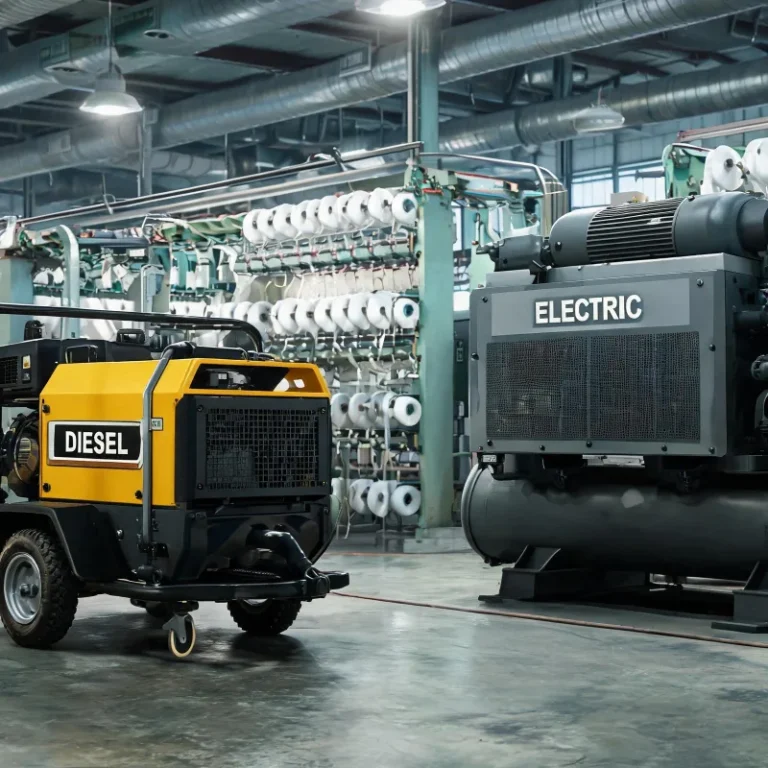
Metric | Diesel Portable Unit | Fixed Electric Unit Grid Outage Resilience | High | Fully dependent on grid power Emissions Impact | Higher | Lower Initial Capital Cost | 30-50% lower | Higher Installation Time | 1-2 days | 2-4 weeks
实施清单
- Calculate total CFM requirement for all active weaving looms
- Verify local emissions rules for continuous diesel operation
- Confirm unit is rated for 24/7 continuous operation, not intermittent use
- Test unit at peak production load before full deployment
- Schedule automatic refueling for overnight operation
- Conduct a full 72-hour continuous run test before integration
误区澄清
- Any diesel mobile unit can handle continuous weaving → Fact: Only heavy-duty units built for 24/7 run times can support continuous operation
- You don’t need extra capacity for peak demand → Fact: Add 15% extra CFM to account for temperature and tension changes
- Diesel mobile units are only for backup use → Fact: Many remote mills use them as the primary compressed air source
决策矩阵
- High grid instability / remote location → Prioritize this solution
- Strict permanent diesel emissions bans → Reject this solution
- Small to mid-sized mill < 100 looms → This solution is ideal
- Existing fully redundant fixed system → This solution is unnecessary
应用场景
- Remote textile mill with unreliable grid access
- Backup compressed air for existing systems during unplanned outages
- Temporary capacity expansion for increased weaving orders
选型指南
- Select a unit rated explicitly for continuous 24/7 industrial operation
- Choose a model with enough fuel capacity for 12+ hours of run time
- Confirm output pressure regulation stays within ±2 PSI for stable weaving
- Prioritize built-in air filtration and drying to prevent fabric contamination
避坑要点
- Don’t skip the 72-hour full load test before full deployment
- Don’t size the unit exactly to peak load, always add 15% extra capacity
- Don’t ignore local emissions rules that can lead to heavy fines
Expert Insights
This solution fills a critical gap for textile mills dealing with growing grid reliability issues across North America — John Miller, Senior Industrial Equipment Consultant, 18 years textile mill experience
Further Reading
- Newly Launched Energy Efficient Diesel Portable Air Compressor for Industrial Use: Trends & Top Picks
- Buy Class Zero Oil-Free Compliant Diesel Portable Air Compressors for Industrial Use
- How to Select a Reliable Diesel Portable Air Compressor for Centrifugal Industrial Projects
- What Size Diesel Portable Air Compressor Do I Need For Industrial Projects
- diesel portable air compressor, textile mill air compressor, continuous weaving operations, industrial compressed air systems – Best New 2024 Dies
- Best Diesel Portable Air Compressors for Oil & Gas Exploration Drilling: Top Picks & Guide
- Best Diesel Portable Air Compressors for Food Processing: Top Picks & Guide
- Diesel Portable Air Compressor vs Electric Stationary Permanent Magnet VFD Screw: Which To Pick?
About the Author

Frequently Asked Questions
How does this solution help with grid instability issues?
A mobile unit can switch online in under two minutes when grid power drops, keeping weaving running without interruption to avoid costly downtime. EIA 2024 data shows most unplanned outages last less than four hours, so a full tank can cover most events.
What CFM size do I need for a 20-loom weaving operation?
Most standard weaving looms require 5-8 CFM each, so a 20-loom operation needs 100-160 CFM plus 15% extra, for a total of 115-184 CFM. Always confirm the specific air requirement for your loom model.
Can this unit be used as the primary compressed air source?
Yes, many remote textile mills with unreliable grid power use these units as their primary source for continuous weaving, as long as they meet local emissions regulations.
How often does a unit running continuous operation need maintenance?
Plan for a full inspection and filter change every 200 run hours, and an oil change and cooling system check every 500 run hours for continuous use.
Is this solution more affordable than a fixed compressed air system?
The initial capital cost is 30-50% lower than an equivalent fixed system, and installation takes just 1-2 days instead of 2-4 weeks, making it ideal for small to mid-sized mills.
What emissions requirements should I check before purchase?
You need to confirm that the unit meets your local and state EPA emissions standards for continuous industrial operation, and check if there are any local restrictions on run time for diesel equipment.