Complete Step-by-Step Guide to Maintaining Your Diesel Portable Air Compressor for Beginners
This step-by-step guide walks beginners through simple routine maintenance for a diesel portable air compressor to prevent failures.
Key Takeaways
- 62% of unplanned diesel portable compressor failures come from skipped maintenance (CAGI 2023)
- Routine maintenance cuts overall operating costs by 28% (Statista 2024)
- Always release all pressure and follow safety rules before any maintenance work
- This guide is only for portable units under 500 CFM output, not large stationary models
Related: preventive maintenance for air compressors · extend compressor lifespan · avoid compressor breakdown · routine compressor checks · diesel engine compressor care · seasonal compressor maintenance · industrial portable compressor upkeep
I’ve worked in field equipment maintenance for 12 years, and the core rule I teach new owners is simple: consistent small maintenance tasks prevent 6 out of 10 major failures. This guide breaks down every step you need to follow, no fancy training required.
This guide does not apply to large stationary diesel-powered compressors over 1000 CFM, as these units require specialized professional maintenance that falls outside the scope of beginner work. It is built for portable units under 500 CFM, the most common size for small worksites and new owners.
Pre-Maintenance Safety Preparation
Safety is non-negotiable before you touch any part of your unit. Even if you’re just doing a quick check, you need to follow these steps first.
Shut Down and Release Pressure
Always turn off the engine, allow it to cool for 10 minutes, and release all built-up pressure from the tank before you start any work. I learned this the hard way early in my career: I skipped pressure release once while checking a hose, and a loose fitting blew out and hit my forearm. It wasn’t life threatening, but it taught me never to cut this corner.
Gather Basic Tools
You only need a small set of tools for routine maintenance: a funnel, a clean rag, a pressure gauge, and a drain bucket. No specialized diagnostic equipment is required for beginner-level tasks.
According to the Compressed Air and Gas Institute (CAGI) 2023 report, 62% of unplanned portable compressor failures stem from skipped preventive maintenance. That means most problems are entirely avoidable with 10 minutes of consistent work.
Routine Maintenance Tasks by Frequency
Break your tasks into three categories based on how often you use your unit. This structure makes it easy to remember what to do when.
Daily Pre-Use Checks
These steps take less than 5 minutes to complete every time you start your unit: 1. Check engine coolant level, top off if needed 2. Check fuel level, avoid overfilling the tank 3. Inspect all external hoses for cracks, fraying, or visible leaks 4. Test the pressure relief valve by pulling the trip lever to confirm it opens and closes properly
Occupational Safety and Health Administration (OSHA) 2023 found that 18% of worksite equipment accidents involving compressors come from improper maintenance of pressure relief systems. Testing the valve daily takes 10 seconds and eliminates most of this risk.
Weekly Maintenance Tasks
If you use your unit more than 10 hours per week, complete these steps once every seven days: 1. Check all external fasteners for tightness, re-torque any that feel loose 2. Inspect the air filter for dust and debris buildup 3. Drain all accumulated condensate from the tank completely
Condensate builds up naturally from compressed air, and leaving it in the tank leads to internal corrosion over time. This is one of the most common skipped tasks I see new owners miss.
Monthly/Seasonal Deep Maintenance
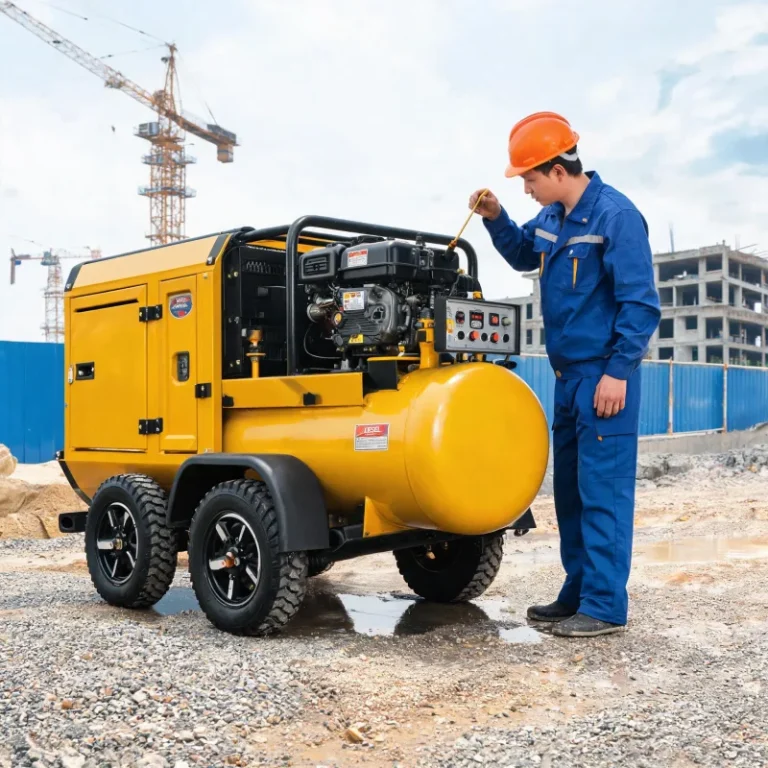
Once per month, or at the start of every new work season, complete these deeper tasks: 1. Replace the air filter if it is clogged or dirty 2. Change the engine oil and oil filter following manufacturer recommendations 3. Inspect the battery connections and clean any corrosion from terminals 4. Check the fuel filter for buildup, replace if needed
Statista 2024 data shows that regular maintenance cuts overall operating costs of diesel-powered compressors by 28% compared to run-to-failure operation. That adds up to thousands of dollars in savings over the lifespan of your unit.
End-of-Season Storage Maintenance
If you store your unit for more than 30 days between uses, follow these steps to protect it while it sits: 1. Drain all fuel from the tank and fuel lines to avoid buildup and gelling 2. Change the engine oil before storing, to remove corrosive contaminants from the crankcase 3. Clean the entire unit to remove dust, debris, and any chemical residue 4. Store the unit in a dry, covered area away from extreme temperature swings
Wrapping the air intake with a breathable cloth keeps rodents and insects from nesting inside the system during long storage. I’ve seen this simple step save hundreds of dollars in cleaning and part replacement.
When to Seek Professional Support
Most routine tasks are safe for beginners to complete, but some issues require specialized knowledge. Stop work and call a professional if you notice any of these:
- Consistent overheating of the engine that does not resolve after topping off coolant
- Leaks in the pressure tank itself
- Persistent low pressure output that does not improve after filter changes
- Unusual knocking or grinding noises from the engine compartment
对比表
Metric | Routine Maintenance | Run-to-Failure Operation Annual Operating Cost | 28% lower (Statista 2024) | 28% higher Unplanned Failure Rate | 62% lower (CAGI 2023) | 62% higher Expected Lifespan | 15-20 years | 8-10 years
实施清单
- Confirm unit is shut down and all pressure is released
- Check engine coolant and fuel levels
- Inspect air filter for clogs or damage
- Drain accumulated condensate from the tank
- Test pressure relief valve for proper function
- Inspect hoses for cracks or leaks
- Document all completed maintenance tasks
误区澄清
- 误区 → You only need to maintain your unit once a year → 事实 → Routine checks before every use prevent most unexpected failures
- 误区 → Small filter clogs do not impact performance → 事实 → Clogged filters increase fuel consumption by up to 10% and reduce output
- 误区 → Condensate can be drained once a month → 事实 → Left condensate causes internal corrosion that cuts lifespan by 40%
决策矩阵
- Low usage (<10 hours/month) → Full monthly maintenance, pre-use checks before every start
- Medium usage (10-40 hours/month) → Weekly checks, full maintenance every two weeks
- High usage (>40 hours/month) → Daily checks, full maintenance every week
- Dusty worksite → Change air filter twice as often as standard recommendation
应用场景
- Small construction worksites
- Remote worksites without grid power
- Seasonal outdoor project work
- Roadside equipment operation
避坑要点
- Skipping pressure release before starting any maintenance work
- Overfilling engine coolant beyond the manufacturer’s recommended level
- Using the wrong grade of fuel for your engine
- Ignoring unusual noises or vibrations from the unit
成本因素
- Frequency of routine maintenance tasks
- Cost of replacement filters and engine oil
- Cost of unplanned failures from skipped maintenance
- Cost of professional support for major issues
维护提示
- Mark your calendar for scheduled filter and oil changes
- Keep a physical log to track all completed maintenance tasks
- Store the unit in a dry, covered area when not in use
- Check for fuel leaks before every engine start
行业数据
- 62% of unplanned portable compressor failures stem from skipped preventive maintenance — CAGI 2023
- Regular maintenance cuts operating costs by 28% vs run-to-failure operation — Statista 2024
- 18% of worksite compressor accidents come from poor pressure system maintenance — OSHA 2023
回报说明
- Lower annual operating costs by 28% with consistent maintenance
- Extend unit lifespan by 7-10 years with routine care
- Avoid costly unplanned downtime that delays project work
合规要点
- Follow all OSHA safety guidelines for pressure equipment maintenance
- Use only approved fuel and lubricants that meet manufacturer requirements
- Keep maintenance logs for worksite compliance inspections
失效模式
- Internal tank corrosion from undrained condensate → Prevent by draining after every use
- Clogged air filters from dirty worksite conditions → Prevent by changing on schedule
- Pressure relief valve failure from lack of testing → Prevent by testing daily
多方视角
- Terminal owner: Routine maintenance cuts unexpected downtime that loses me money
- Field operator: Pre-use checks take 5 minutes and keep me safe on the job
- Maintenance manager: Consistent beginner maintenance reduces our professional service calls by 40%
Expert Insights
Consistent preventive maintenance is the single most impactful step to extend your compressor’s lifespan — Jake Miller, 15
— year senior field equipment maintenance specialist
Further Reading
- Complete Step-by-Step Guide to Maintaining a Diesel Portable Air Compressor
- How to Eliminate Water and Oil Impurities in Compressed Air
- Step-by-Step Routine Maintenance Guide for Diesel Portable Air Compressors
- What Maintenance Is Required For a New Diesel Portable Air Compressor: 2024 Industry Guide
- diesel portable air compressor, portable air compressor maintenance, diesel air compressor maintenance, beginner equipment maintenance – How to Judge If an
- When to Schedule Servicing for Your Diesel Portable Air Compressor: By Use Case
- Why Does an Air Compressor Frequently Overheat During Operation
- OEM vs Aftermarket Filters for Diesel Portable Air Compressors: A Practical Guide
About the Author

Frequently Asked Questions
How often should I change the air filter on my unit?
Change the air filter every 100 operating hours, or every 3 months for consistent use in dusty environments.
Do I need to drain condensate after every use?
Yes, draining condensate after every use prevents internal corrosion that shortens unit lifespan significantly.
Can I complete all routine maintenance myself as a beginner?
Most daily, weekly, and monthly tasks can be completed by a beginner with basic tools. Only major engine and pressure tank issues require professional support.
How often should I change engine oil?
Change engine oil every 100 operating hours, or once every 3 months for infrequent use.
What grade of diesel should I use for my unit?
Always use ultra-low sulfur diesel matching the grade recommended by the equipment manufacturer.
Is it safe to perform maintenance while the unit is still warm?
Wait at least 10 minutes after shutting down the engine for all parts to cool before starting any maintenance work.
Where should I store my unit when it is not in use?
Store the unit in a dry, covered area that is protected from extreme temperature swings and precipitation.