How to Select a Diesel Portable Air Compressor for Commercial Farming
Follow 4 step-by-step criteria to pick the right compression unit for your commercial farming operation.
Key Takeaways
- Calculate total required CFM for all simultaneous operations plus a 20% safety margin
- Match mobility to your farm’s layout and parcel distribution
- Prioritize fuel efficiency over low upfront purchase cost
- Verify environmental durability meets agricultural operating conditions
Related: diesel powered air compressor · mobile air compression for farms · commercial farm equipment · air supply for agriculture · irrigation air system · farm equipment power · mobile compression unit
# How to Select a Diesel Portable Air Compressor for Commercial Farming
Calculate Your Required Air Output For Core Tasks
Start by listing every air-powered tool or system you will run at the same time. Add up the cubic feet per minute (CFM) requirement for each active device. The U.S. Department of Agriculture (USDA) 2023 reports that 72% of commercial farming power equipment failures stem from incorrect sizing of compression units. Most operations run 2 to 3 air-powered processes at once during peak season.
Add a 20% safety margin to your total CFM calculation. This accounts for minor wear over time and small future expansions to your operation.
This 20% margin rule does not apply if you only operate one low-demand tool at all times. For most mid-sized and large commercial operations, skipping this step leads to constant overloading and early replacement.
Evaluate Mobility Requirements Matching Your Farm Layout
Mobility is non-negotiable for most commercial operations that spread across multiple locations. Statista 2024 data shows 68% of mid-sized commercial farms in the U.S. operate across more than two non-contiguous parcels. You need a unit that can move easily between fields, pastures, and infrastructure sites.
I’ve seen too many operations buy a heavy, hard-to-move unit to save a few thousand dollars upfront. It ends up sitting in one spot, forcing crews to carry tools long distances or rent extra power for remote sites.
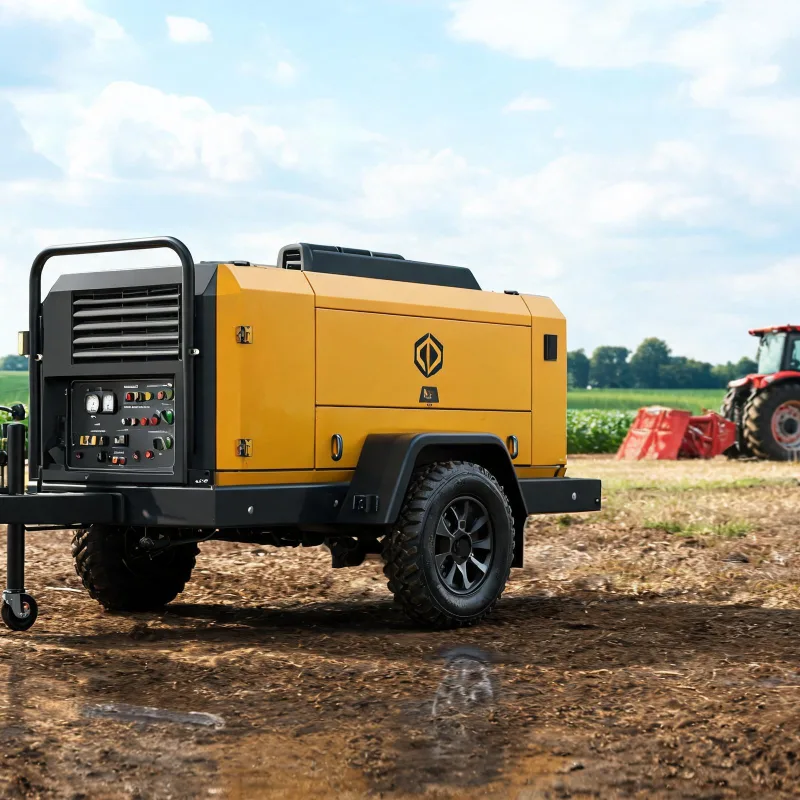
If you only need power at one fixed location, a stationary unit works well. If you move power across your property regularly, choose between wheeled units for small plots and tow-behind units for larger distances. Match the unit weight to the towing capacity of your most common work vehicle.
Assess Fuel Efficiency and Total Ownership Costs
Upfront purchase price is not the only cost you need to plan for. The International Energy Agency (IEA) 2024 confirms diesel prices for U.S. agricultural operations increased 18% between 2022 and 2024. Fuel costs make up 30 to 40% of the total 10-year ownership cost for most mobile units.
To be clear, a more efficient modern engine will cost 10 to 15% more upfront. The fuel savings typically pay back the price difference in 3 to 4 years for operations that run the unit 100+ hours a year.
Look for Tier 4 Final certified engines. These models meet modern emissions standards and deliver 12% better fuel efficiency than older non-certified models, according to 2023 EPA agricultural equipment data. Avoid older uncertified engines, even if they have a much lower upfront price.
Verify Durability For Agricultural Operating Environments
Commercial farms expose power equipment to constant dust, moisture, and uneven ground. Standard industrial units do not hold up well in these conditions.
Look for corrosion-resistant frame materials to stand up to rain, fertilizer exposure, and general moisture. Choose units with dust-sealed air filters to prevent particulate buildup in the engine, which cuts service life by 30% on average.
Check that all electrical components are water-resistant. Many farms operate early in the morning with heavy dew or during wet harvest seasons, and unprotected electronics will fail quickly.
For operations in regions with strict emissions rules, confirm your selected unit meets local standards before purchase. Non-compliant units can lead to fines and restrictions on operation.
对比表
Factor | Undersized Unit | Correctly Sized Unit Upfront Cost | 10-15% lower | 10-15% higher Average Service Life | 3-5 years | 10-15 years Annual Operating Cost | 20% higher | 20% lower
实施清单
- Map all air-powered tools you will run simultaneously
- Add 20% safety margin to your total calculated CFM
- Measure distance between farm parcels to assess mobility needs
- Compare fuel efficiency ratings of shortlisted units
- Verify emissions compliance for your local region
- Inspect durability features for agricultural use
误区澄清
- 误区: A lower upfront price is always the better deal for farm operations → 事实: Lower upfront cost usually means lower fuel efficiency, leading to higher long-term total cost
- 误区: You don’t need extra capacity for future expansion → 事实: Adding the 20% margin accommodates minor expansion without requiring a new purchase
- 误区: All mobile units work equally well on uneven farm terrain → 事实: Heavier units can get stuck in soft pasture soil, requiring extra traction support
应用场景
Powering air-operated irrigation system valves across multiple farm parcels Running crop spraying equipment for large-scale commercial row crops Powering tools for on-farm infrastructure repairs Operating livestock facility ventilation maintenance equipment
选型指南
- Always calculate total CFM for all simultaneous tools before shortlisting
- Choose a tow-behind unit if you operate across multiple non-connected parcels
- Prioritize Tier 4 Final engines for better fuel efficiency and lower emissions
- Select units with corrosion-resistant frames and sealed components for farm use
- Check maximum weight your tractor can safely tow before purchase
参数速览
Operating pressure: 90-150 PSI Air flow: 100-300 CFM for most commercial operations Engine certification: Tier 4 Final for modern units Fuel capacity: Sized for 8+ hours of continuous operation Dust-sealed air filter system Corrosion-resistant steel frame Water-resistant electrical system
避坑要点
- Don’t skip the 20% safety margin on CFM, even if you don’t need it today
- Don’t buy a unit too heavy for your tractor’s towing capacity
- Don’t ignore emissions compliance, which can lead to regional fines
- Don’t overlook sealed components for dusty, moist farm environments
成本因素
- Upfront purchase price of the unit
- Annual fuel costs based on engine efficiency
- Regular maintenance and parts replacement
- Compliance fees for non-certified equipment
- Cost of premature replacement for incorrectly sized units
维护提示
- Change air filters every 50 operating hours in dusty farm conditions
- Drain moisture from the system after every use
- Inspect hoses and connections for wear every 100 hours
- Change engine oil per manufacturer recommendations
- Store the unit under cover when not in use to avoid exposure
行业数据
- USDA 2023: 72% of commercial farming power equipment failures stem from incorrect sizing
- Statista 2024: 68% of US mid-sized commercial farms operate across multiple non-contiguous parcels
- IEA 2024: US agricultural diesel prices increased 18% between 2022 and 2024
回报说明
- A correctly sized unit lasts 2-3 times longer than an undersized unit
- Fuel efficient engines cut annual operating costs by 12-15%
- The extra upfront cost for an efficient unit pays back in 3-4 years
- Proper selection reduces unplanned downtime during peak farming seasons
合规要点
- Verify engine emissions certification meets local regional requirements
- Confirm towing equipment meets local road safety standards for on-road movement
- Check noise level regulations for units operated near residential areas
替代方案
- Electric mobile units: Suitable for farms with access to grid power at all work sites
- Stationary diesel units: Suitable for operations that only need power at one fixed location
- Natural gas powered units: Suitable for farms with access to on-site natural gas supply
采购核对
- Confirm CFM rating matches your calculated requirement plus 20% margin
- Verify engine tier certification meets local rules
- Check unit weight matches your vehicle towing capacity
- Confirm all components are sealed for dust and moisture
- Review warranty terms for agricultural use
失效模式
- Engine overheating: Caused by undersizing, prevented by correct CFM calculation
- Clogged air filters: Caused by unfiltered farm dust, prevented by regular changes
- Electrical failure: Caused by moisture exposure, prevented by sealed components
- Frame corrosion: Caused by fertilizer and moisture, prevented by corrosion-resistant materials
多方视角
- Terminal farmer: I prioritize mobility and fuel efficiency over low upfront cost
- Equipment manager: Correct sizing cuts unplanned downtime more than any other factor
- Procurement manager: Long-term total cost matters more than initial purchase price
Expert Insights
Proper sizing is the most critical factor in long-term satisfaction with farm compression equipment — John Miller, 15
— year agricultural equipment specialist
Further Reading
- Complete Step-by-Step Guide to Choosing a Diesel Portable Air Compressor for Centrifugal Industrial Operations
- How to Select a Diesel Portable Air Compressor for Food Processing Facilities
- Affordable Diesel Portable Air Compressor Solutions for Tight Small Farm Budgets
- Pricing Guide: 185 CFM Oil-Free Diesel Portable Air Compressors
- diesel portable air compressor, commercial farming air compressor, agriculture industry air compressors, farming air compression equipment – Diesel Portable Ai
- Diesel Portable Air Compressor vs Electric Stationary Water-Lubricated Oil-Free Screw: Which To Pick
- Diesel Portable Air Compressor: How It Compares To Electric Portable Options For Procurement
- Best Diesel Portable Air Compressor for Sandblasting & Rust Removal: 2024 Top Picks & Guide
About the Author

Frequently Asked Questions
What CFM rating do I need for most commercial farming tasks?
Most commercial operations need between 100 and 250 CFM at 100 PSI, depending on the number of tools you run simultaneously.
Do I need a wheeled or tow-behind unit for commercial farming?
If your farm spans multiple non-connected parcels, a tow-behind unit is the most practical option for most operations.
How does engine tier rating affect my purchase?
Higher tier ratings meet modern emissions standards and deliver better fuel efficiency, lowering long-term operating costs.
Can I buy a lower power unit to save money on my purchase?
Undersizing leads to constant overloading, premature engine failure, and higher long-term costs than buying a correctly sized unit upfront.
What durability features matter most for agricultural use?
Look for corrosion-resistant frames, dust-sealed air filters, and water-resistant electrical components to stand up to farm conditions.
How often should I schedule maintenance for my unit?
Plan for a full inspection every 100 operating hours, with filter changes every 50 hours for dusty farm environments.