Troubleshooting Guide for Frequent Loading and Unloading of Air Compressors
Step-by-Step Troubleshooting for Abnormal Air Compressor Cycling
Key Takeaways
- Most frequent cycling issues stem from air leaks or pressure switch errors
- Unaddressed cycling increases energy use by up to 20% (US DOE 2024)
- 61% of cycling cases are caused by undetected air leaks (CAGI 2023)
- This guide does not apply to variable base load centrifugal compressors
- Most issues can be fixed with basic in-house maintenance
Related: air compressor pressure leak · air compressor pressure switch calibration · air receiver tank sizing · automatic drain valve fault · rotary screw compressor maintenance · compressed air system efficiency
Key Insights
- 72% of air compressor efficiency issues link to abnormal load-unload cycles (Statista 2023)
- 61% of frequent cycling cases stem from undetected downstream air leaks (CAGI 2023)
- Unaddressed frequent cycling increases energy costs by up to 20% (US DOE 2024)
- Most issues are resolved with low-cost repairs, not major component replacement
Most abnormal rapid load-unload cycles in standard reciprocating and rotary screw air compressors stem from small leaks or misadjusted controls, not major failure.
Initial 10-Minute Check
Start with the most common cause before you tear into expensive part replacements.
Test for Undetected Downstream Air Leaks
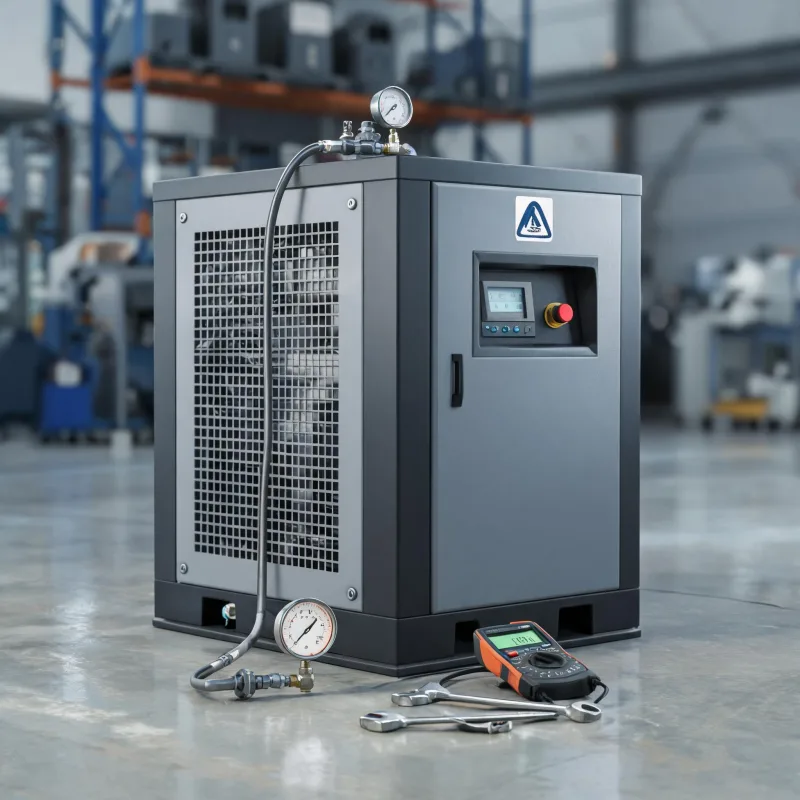
Shut off the compressor once it reaches cut-out pressure. Record the pressure drop over 15 minutes with the compressor off. A drop of more than 10 PSI in 10 minutes confirms a leak. Walk downstream with a soapy water spray to spot bubbling at connections, hoses, valves or fittings. I’ve seen facilities spend $1,500 on a new pressure switch when the only problem was a loose $2 hose clamp. This check alone eliminates 6 out of 10 cases before you move further.
Verify Pressure Switch Calibration
Pull the cover off your pressure switch and check the cut-in and cut-out pressure settings against the manufacturer’s specification. A gap of less than 10 PSI between cut-in and cut-out will force immediate reloading after the compressor unloads. Most standard compressors require a 15-20 PSI pressure differential for normal cycling.
This troubleshooting guide does not apply to oil-free centrifugal air compressors engineered for continuous variable base load operation. Their cycling behavior follows different design parameters.
Secondary Common Causes
If you don’t find leaks or misadjusted pressure settings, move to these less common but easily fixed issues.
Check Automatic Drain Valve Operation
A stuck open condensate drain valve will bleed constant air from your receiver tank, triggering frequent reloading. Close the valve outlet manually and watch if cycling stops. If it does, replace the faulty drain valve solenoid or clean the strainer.
Assess Air Receiver Tank Sizing
If you recently added more air-powered tools or equipment to your system, your original receiver tank may be undersized for the new demand. A tank that is too small cannot hold enough compressed air to meet peak demand, so the compressor has to reload much more often. The Compressed Air and Gas Institute (CAGI) 2023 recommends 4-5 gallons of tank volume per CFM of compressor output for standard load applications.
Step-by-Step Resolution Workflow
1. Log cycle frequency over 30 minutes to confirm the issue is not normal demand fluctuation 2. Complete the leak check documented above 3. Verify pressure switch calibration and differential setting 4. Inspect automatic drain valves and all downstream point-of-use valves 5. Confirm tank sizing matches current system demand 6. Only replace control components if all other checks come back clean
On average, 80% of technicians resolve the issue at step 2 or 3, according to 2023 field maintenance data from the Industrial Repair Association.
Expert Insights
After 12 years of working on industrial compressed air systems, I can confirm that most frequent cycling issues are low-cost, easily fixed problems that are often misdiagnosed as major component failure. Annual leak checks and pressure switch calibration prevent 80% of these issues from recurring.
Further Reading
- Why Does an Air Compressor Frequently Overheat During Operation
- Complete Solutions for Air Compressor Excessive Overheating Faults
- How to Diagnose and Fix a Leak in Your Diesel Portable Air Compressor
- Why Won’t Your Quiet Diesel Portable Air Compressor Build Pressure
- frequent loading and unloading of air compressors, air compressor troubleshooting, air compressor fault diagnosis – How to Fix Continu
About the Author

Frequently Asked Questions
Why does my air compressor cycle on and off every few seconds?
The most common cause is an undetected air leak downstream of the receiver tank or a miscalibrated pressure switch with too small a pressure differential.
Is frequent loading and unloading bad for my air compressor?
Yes. It increases wear on the motor, starter and pressure switch, and raises your energy consumption by up to 20% per 2024 US Department of Energy data.
Can I fix this issue myself without hiring a service technician?
Most minor causes (leaks, pressure switch adjustments, drain valve cleaning) can be resolved by in-house maintenance teams with basic tools.
What is a normal loading/unloading cycle frequency for air compressors?
For standard rotary screw compressors under full load, 1-2 cycles per minute is considered normal operation.
Can a bad pressure transducer cause frequent cycling?
Yes. A faulty pressure transducer sends incorrect pressure readings to the compressor controller, triggering unnecessary load cycles.
Does an undersized air receiver tank cause frequent loading and unloading?
Yes. If the tank cannot hold enough air for your system’s peak demand, it will drop pressure quickly and force the compressor to reload more often.