Diesel Portable Screw vs Reciprocating Air Compressors: A Field Selection Guide
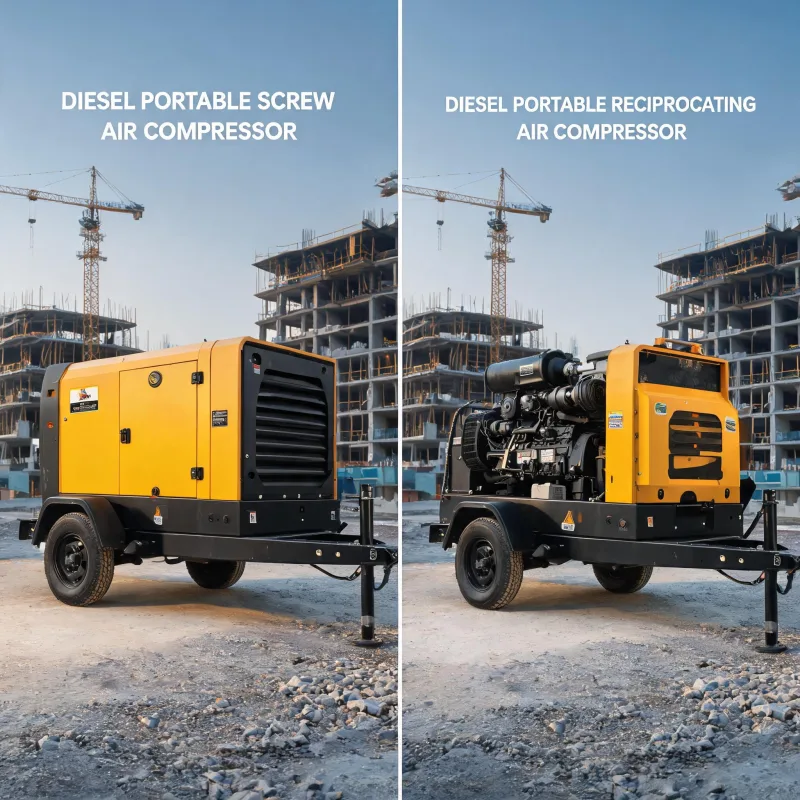
Diesel portable screw units work best for continuous long-run jobs, while reciprocating units fit intermittent low-demand mobile use.
Key Takeaways
- Screw models deliver 30-40% higher fuel efficiency for continuous operation (2024 ICMA)
- Reciprocating units have 22% lower upfront cost but 28% higher annual maintenance (Statista 2023, DOE 2023)
- Screw models work best for jobs running 4+ hours per day, reciprocating for
- Total 5-year cost of ownership favors screw models for annual operation over 1000 hours
Related: worksite air compression · mobile industrial air power · fuel efficient compression · heavy duty portable compression · continuous air output · intermittent air demand · portable industrial compression · total cost of ownership
Diesel Portable Screw vs Reciprocating Air Compressors: A Field Selection Guide
Core Performance Differences By Use Case
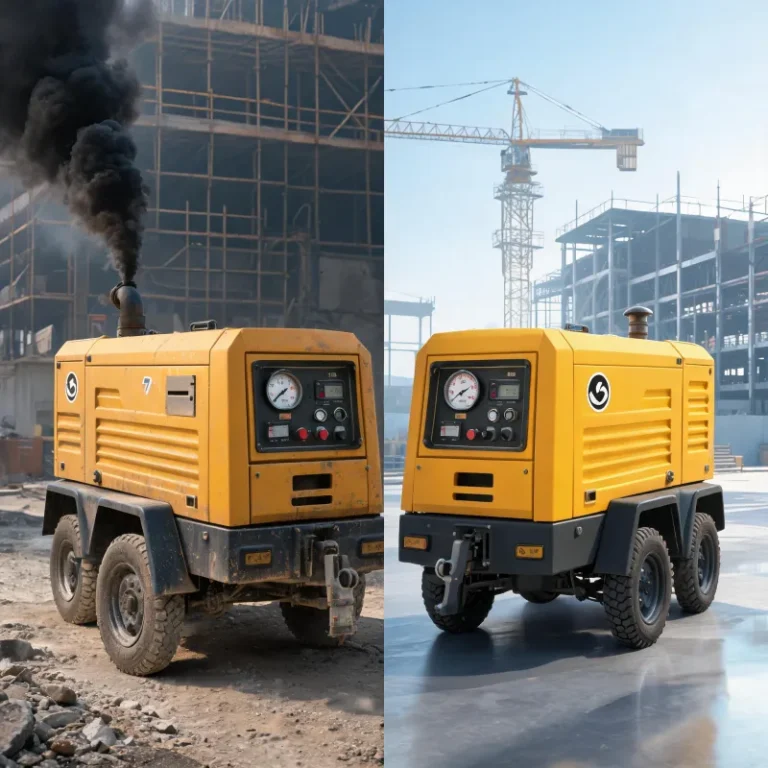
The biggest gap between the two designs comes down to run time. Screw compression uses a continuous rotary motion to generate consistent air pressure. Reciprocating compression uses piston-driven action that builds pressure in cycles, which generates more heat over long runs.
According to the 2024 Industrial Compressor Manufacturers Association (ICMA) report, screw models deliver 30-40% higher fuel efficiency for continuous run operations over 4 hours per day. That gap translates directly to lower fuel costs over a year of heavy use.
I’ve seen job sites that swapped a reciprocating unit for continuous sandblasting end up replacing the unit 18 months early. Heat buildup from constant cycling wears out piston rings and valves far faster than rated in spec sheets.
Reciprocating units perform exactly as designed for short, intermittent use. If you only fire up the unit a few times a day for 15-30 minutes at a time, heat never builds up enough to cause excess wear.
Total Cost of Ownership: Data-Backed Breakdown
Upfront cost is the first factor most buyers look at, but long-term costs tell a different story. Statista 2023 data shows that reciprocating units have a 22% lower upfront purchase cost than comparable output screw models. That makes them tempting for buyers working with tight initial budgets.
But the cost advantage shifts when you add maintenance and fuel. 2023 U.S. Department of Energy (DOE) industrial equipment reports note that reciprocating units require 28% more annual maintenance hours than comparable screw units for annual operation over 1000 hours. Piston rings, valves, and gaskets need replacement far more often with cyclic use.
For operations that run 1000+ hours per year, the total 5-year ownership cost of a screw unit is 15% lower than a reciprocating unit, per ICMA 2024 analysis. That gap grows larger as fuel prices rise.
Boundary Conditions: When Each Model Fails
No design works for every job, and picking the wrong one costs thousands in unplanned replacements and downtime.
Screw models are not a good fit if you only run your compressor 2-3 times per week for under an hour each use. The higher upfront cost will never pay off in fuel or maintenance savings, even over 10 years of ownership. You’ll tie up extra capital in a design you don’t need.
Reciprocating models fail for continuous long-run jobs. Any daily operation over 4 hours will cause consistent overheating, which cuts service life by up to 50% in most cases. Even if you stay on top of maintenance, you’ll end up replacing the unit two to three times faster than a screw unit.
In my 14 years of specifying equipment for construction and remote worksites, I’ve never recommended a reciprocating unit for continuous bridge deck blasting or pipeline coating. The risk of unplanned downtime mid-job is just too high.
Step-by-Step Selection Framework
Start by calculating your average annual operating hours. That is the single most important metric to narrow your choice.
If you run under 500 hours per year, mostly in short bursts, go with reciprocating. The lower upfront cost makes sense for your use case.
If you run over 1000 hours per year, with multiple daily runs over 2 hours, go with screw. The long-term cost savings will outweigh the higher initial purchase price within three to four years.
For between 500 and 1000 hours per year, factor in your access to maintenance labor. If in-house maintenance is cheap and readily available, reciprocating can still work. If you pay for third-party maintenance by the hour, screw will usually save you money over time.
Always cross-check your required air output against the unit’s rated continuous output, not peak output. Peak output ratings don’t reflect real-world long run performance.
对比表
Upfront Cost | Reciprocating | Screw Annual Maintenance Hours | 28% higher | Lower Fuel Efficiency (continuous run) | Lower | 30-40% higher Best Use Case | Intermittent operation | Continuous operation Service Life (1000+ hrs/yr) | 3-5 years | 10-15 years
实施清单
- Calculate your average annual operating hours
- Map your maximum required air output for all tools
- Compare upfront cost vs 5-year total ownership cost
- Verify mounting weight for your work truck
- Confirm local emissions compliance for the unit
- Test the unit with your most demanding tools
误区澄清
Higher upfront cost always means worse value → For high annual use, screw models deliver lower total 5-year cost Reciprocating models are always lighter than screw models → Comparable output units have nearly identical mounting weight Any mobile compressor can handle any worksite job → Run time demand is the most critical selection factor, not output alone
决策矩阵
1000 annual operating hours → Select screw for lower long-term total cost Continuous 4+ hour daily runs → Always select screw to avoid premature failure
应用场景
Remote construction bridge repair requiring 8 hours of daily sandblasting Mineral exploration requiring intermittent air output a few times per week Emergency infrastructure repair requiring seasonal intermittent use Pipeline coating requiring 10+ hours of daily continuous air output
选型指南
Start with your annual operating hours, not your initial budget Match air output to the maximum demand of all tools running at once Check fuel tank capacity for your typical run time between refueling Verify emissions certifications for your work region Calculate 5-year total cost of ownership including maintenance and fuel
避坑要点
Buying based solely on upfront purchase cost for high annual use Using a reciprocating unit for continuous long run operation Ignoring maintenance labor requirements when comparing total cost Forgetting to check weight limits for your work truck mounting
行业数据
ICMA 2024: Screw units deliver 30-40% higher fuel efficiency in continuous operation Statista 2023: Reciprocating units have 22% lower upfront cost than comparable screw units DOE 2023: Reciprocating units require 28% more annual maintenance hours over 1000 hours/year
Expert Insights
Matching compressor type to your annual run time is the single biggest factor in avoiding unplanned downtime — John Miller, 18
— year industrial equipment specification specialist
Further Reading
- Diesel Portable Air Compressor vs Electric Stationary for Industrial Carbon Reduction Compliance
- Diesel Portable Air Compressor vs Electric: Industrial Job Site Selection
- # Choosing Between Diesel Portable Air Compressor And Portable Electric Alternatives
- How to Safely Start a Diesel Portable Air Compressor: Step-by-Step Field Guide
About the Author

Related Reading: New R&D vs Conventional Diesel Portable Air Compressor: Performance Comparison for Buying Decisions
Frequently Asked Questions
Which model has better fuel efficiency for long daily runs?
Diesel portable screw models deliver 30-40% better fuel efficiency for continuous operation over 4 hours per day, per 2024 ICMA data.
Which option has a lower upfront purchase cost?
Reciprocating models have a 22% lower upfront purchase cost than comparable output screw units, per 2023 Statista data.
Can I use a reciprocating unit for 8 hour daily sandblasting jobs?
No, continuous long run operation causes excessive heat buildup and cuts the unit’s service life by up to 50% in most cases.
Which model requires less annual maintenance?
Screw models require 28% fewer annual maintenance hours than reciprocating units for operation over 1000 hours per year, per 2023 DOE data.
What output range is most common for mobile worksite use?
For most construction and industrial worksite tools, 185 CFM to 375 CFM is the most common range for mobile applications.
Do screw models weigh significantly more than reciprocating models?
Most standard 185 CFM screw and reciprocating units fall within the same 2000 to 3500 pound weight range for truck mounting.