How to Judge If an Air Compressor Air End Needs Replacement
How to Judge When Your Compressor Air End Needs Replacement
Key Takeaways
- Early warning signs include increased noise, higher energy use, and pressure drops
- A worn air end increases energy consumption by up to 25%
- 78% of unplanned compressor outages stem from neglected air end failure
- Replacement is needed if output drops 15% below manufacturer specs
- Low-use backup air ends can last far longer than continuous use units
Related: air compressor maintenance · air end failure warning signs · compressed air system efficiency · screw air end replacement · industrial air compressor repair
- 78% of unplanned air compressor failures stem from worn air ends, per CAGI 2023
- A worn air end can raise system energy use by up to 25%, per US DOE 2023
- 62% of facilities replace air ends 1-2 years early, adding unnecessary costs
- Replacement is required if output drops 15% below manufacturer specs
If you’re seeing consistent pressure drops, higher energy bills, or unusual noise from your compressor, you likely need a new air end. Waiting for catastrophic failure will cost 3x more than proactive replacement.
Common Warning Signs of Imminent Failure
Unusual noise and persistent vibration are the first visible signs of worn air end components. Worn bearings or damaged rotors create friction that causes consistent, low-frequency rumbling you can feel through the compressor casing.
Increased energy consumption is a less obvious but more costly warning. US Department of Energy (DOE) 2023 data confirms that a worn air end with excessive rotor clearance increases overall system energy consumption by up to 25% when compared to a properly functioning new unit.
Consistently low output pressure is another clear sign. If your system can’t reach the required working pressure even after adjusting the regulator, the air end is no longer compressing air efficiently.
In my 12 years working on industrial compressed air systems, I’ve seen operations push a bad air end for 6 months longer than they should have just to avoid a shutdown. That almost always leads to secondary damage to the compressor block, driving up total repair costs by 200% or more.
Industry Benchmarks for Your Replacement Decision
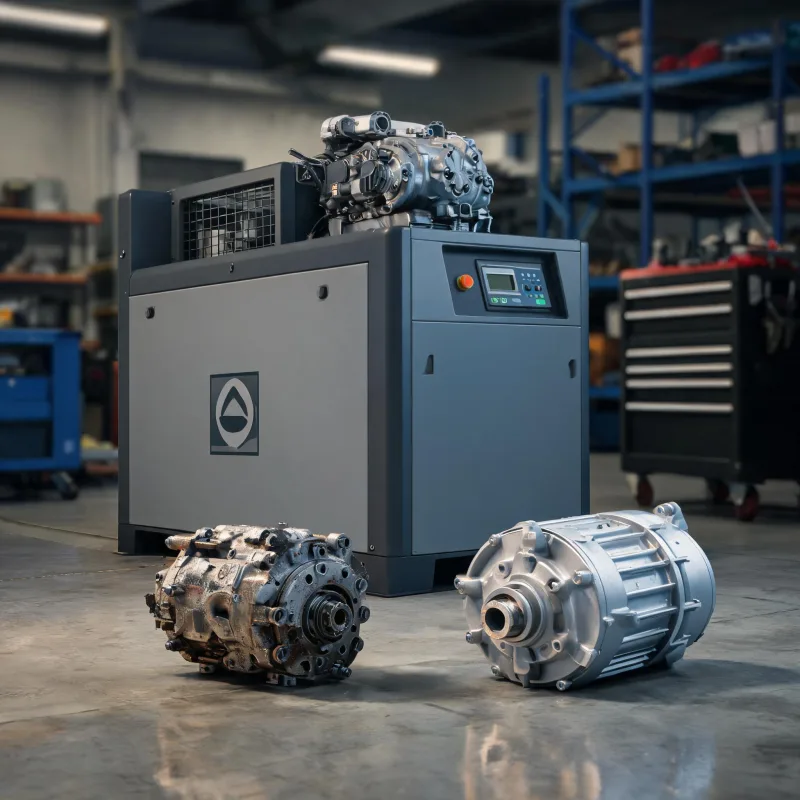
Most rotary screw air ends are designed for 60,000 to 80,000 hours of continuous 24/7 operation. If your unit has passed this threshold, you should schedule a full inspection to assess wear.
Statista 2024 found that 62% of North American industrial facilities replace air ends 1 to 2 years earlier than necessary, adding an average of $1,200 in annual unnecessary costs for 100hp systems. Replacement is not always required just because the unit hit the hour mark.
This 80,000 hour rule does not apply to air ends in low-use backup applications that run less than 500 hours per year. I’ve seen 15 year old low-use air ends still operating within spec with just routine bearing changes.
Compressed Air and Gas Institute (CAGI) 2023 data adds that 78% of unplanned air compressor outages are caused by neglected air end failure. Proactive annual inspections can cut this risk by more than 60%.
Step-by-Step Testing to Confirm Replacement
Check Output Pressure Against Manufacturer Specs
Run the compressor at full load with all downstream valves open. Measure discharge pressure directly at the air end outlet. If output is 15% or more below the unit’s rated output spec, replacement is required.
Check Rotor Clearance and Alignment
Use a laser alignment tool to check rotor clearance against factory tolerance. Excessive clearance between the meshing rotors is the leading cause of efficiency loss. If clearance exceeds 0.2mm beyond the acceptable range, repair is rarely cost effective.
Compare Energy Use Baseline
Pull 12 months of energy use data for the compressor. Compare current energy consumption per 100 CFM of output to the baseline when the air end was new. If consumption has risen more than 10%, replacement will pay for itself in 2-3 years through lower energy bills.
When Repair Works (And When It Doesn’t)
Minor issues like worn seals or bearings can be repaired for 30-50% of the cost of a new air end. But if you have rotor damage, cracked housing, or excessive wear to the rotor lobes, replacement is the only long-term solution.
Even successful repairs will only extend the life of the air end by 2-3 years in most cases. For high-demand 24/7 operations, replacement is almost always a better long-term investment.
Expert Insights
Proactive annual testing for air end wear reduces unplanned downtime and avoids unnecessary early replacement costs, saving industrial facilities thousands of dollars annually.
Further Reading
- When to Schedule Servicing for Your Diesel Portable Air Compressor: By Use Case
- Why Does an Air Compressor Frequently Overheat During Operation
- OEM vs Aftermarket Filters for Diesel Portable Air Compressors: A Practical Guide
- Comparing Maintenance Requirements: Diesel Portable Air Compressor vs Gas
- how to judge if an air compressor air end needs replacement – Diesel Portable Ai
- How Often Should I Change Oil In My Small Diesel Portable Air Compressor
- Air Compressor Buying & Sizing Guide: Warranty, Maintenance & Sizing Rules
- What Is the Difference Between Screw and Piston Air Compressors
About the Author

Frequently Asked Questions
What is the average lifespan of a screw air end?
For continuous 24/7 industrial use, the average lifespan is 8 to 10 years, or 60,000 to 80,000 operating hours.
Can I repair a worn air end instead of replacing it?
Minor bearing or seal wear can be repaired, but excessive rotor clearance or rotor damage almost always requires full replacement to restore rated efficiency.
How much does a new air end cost for a 100hp industrial compressor?
For most common 100hp rotary screw units, a new OEM air end costs between $4,000 and $8,000 before installation labor.
What happens if I keep running a compressor with a bad air end?
A worn air end will continue to lose efficiency, raise energy costs, and can eventually fail catastrophically, damaging other compressor components and causing unplanned production downtime.
Do oil-free air ends need replacement on the same timeline as oil-injected units?
Most oil-free air ends have a shorter average lifespan of 6 to 8 years for 24/7 use, due to tighter tolerances and higher operating temperatures.
How often should I check my air end condition?
For 24/7 industrial operations, you should inspect your air end once every 12 months and check operating metrics quarterly.