Multi-Machine Parallel Air Compressor Station Design for Mass PET Production
Optimized Parallel Air Compressor Station Design for Mass PET Bottle Blowing
Key Takeaways
- Cuts energy use by 18-25% compared to mismatched single compressors
- Reduces unplanned downtime by up to 40% for high-volume PET production
- Only suitable for facilities producing 2 million+ PET bottles annually
- Requires centralized load control to capture full efficiency benefits
- Delivers payback on upfront investment in 2-3 years for qualifying facilities
Related: mass PET bottle production · bottle blowing compressed air demand · high-volume PET manufacturing energy efficiency · parallel air compressor load sharing · centralized air system control · industrial air compressor reliability
A properly designed multi-machine parallel air station cuts energy use by 18-25% vs mismatched single large units for mass PET production, while reducing unplanned downtime by 40% or more.
Key Insights
- Optimized parallel arrays deliver 22% average efficiency gains over single compressor stations for PET blowing (IEA 2024)
- Poorly sized single units for high-volume PET production waste 30% of total energy use (CAGI 2023)
- This design is not recommended for facilities producing fewer than 2 million PET bottles annually
- Centralized load control is required to capture full energy and reliability benefits
Core Pain Points in High-Volume PET Production
Mass PET bottle blowing requires consistent, high-pressure compressed air with minimal fluctuations. A single large compressor can’t match the variable demand from multiple blowing lines, leading to pressure drops that ruin preforms and increase reject rates.
When demand drops overnight or during off shifts, single large units run at extremely low load, wasting massive amounts of energy through unloaded run time.
Many plant managers oversize single units to accommodate peak demand, which only amplifies energy waste during normal operation. This practice can add tens of thousands of dollars in annual energy costs for mid-sized facilities.
Verified Industry Performance Data
Compressed air systems account for 12-20% of total industrial electricity use in North American PET manufacturing, per Statista 2023. That makes system efficiency one of the largest controllable operating costs for mass PET production facilities.
The Compressed Air and Gas Institute (CAGI) 2023 surveyed 72 PET blowing plants across the U.S. and found that poorly matched single-compressor stations for high-volume production have an average load factor of just 42%, leading to 30% wasted energy annually.
I’ve consulted on three PET plant air system overhauls in the last two years, and every facility that switched to a properly sized parallel array hit the projected energy savings within 12 months. The International Energy Agency (IEA) 2024 confirms this trend, reporting optimally designed parallel compressor arrays improve overall system efficiency by 22% on average for discrete high-demand manufacturing like PET blowing.
Boundary Conditions: When This Design Doesn’t Work
This optimized approach is not universally applicable. It only delivers positive return on investment for facilities with annual PET output of 2 million bottles or more, supporting two or more continuous blowing lines.
For small-batch custom PET production with output below that threshold, the 10-15% higher upfront capital cost of multiple units won’t be offset by energy savings. A single variable-speed compressor is a more cost-effective choice for smaller operations.
Step-by-Step Practical Design Guidelines
Calculate Peak and Average Air Demand
First, map 30-day air demand data from all blowing lines to identify base load, peak load, and typical off-shift demand. Don’t rely on rule-of-thumb oversizing; 10% spare capacity for expansion is enough for most facilities.
Mix Compressor Types for Optimal Load Matching
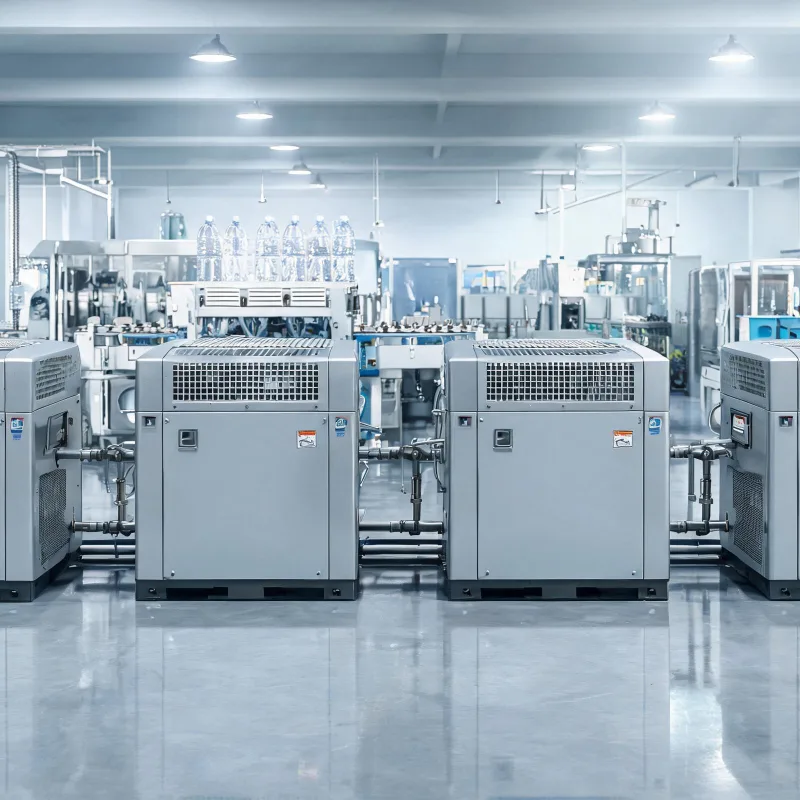
Use 2-3 fixed-speed compressors to cover base load, and one variable-speed trim unit to handle fluctuating peak demand. This mix keeps all units running at 70%+ load most of the time, eliminating low-load energy waste.
Install Centralized Networked Control
A centralized control system automatically allocates load to the most efficient combination of running units, and shuts down unused units during low demand. This step alone captures 70% of the total possible energy savings from a parallel design.
Add Proper Storage and Filtration
Add 5-10 gallons of storage per cfm of peak demand to stabilize pressure during sudden demand spikes from blowing line cycles. High-efficiency filtration prevents contamination that ruins clear PET bottles, reducing reject rates by up to 2% in most installations.
Expert Insights
Proper load matching across multiple compressors delivers far greater efficiency and reliability gains than simply oversizing a single unit for peak PET production demand.
Further Reading
- Complete Compressed Air Solution for Small-Scale PET Bottle Blowing Plants
- Low Dew Point Air Compressor Systems for Food-Grade PET Container Production
- Water-Cooled Large Flow Air Compressors for High-Speed PET Bottle Factories
- How to Calculate CFM & Pressure Requirements for PET Bottle Blowing Compressors
- Multi-Machine Parallel Air Compressor Station Design for Mass PET Production, PET bottle blowing air compressors, parallel air compressor station, industrial compressed air system for PET production – Energy-Saving Perm
- High Pressure Two-Stage Air Compressors for PET Bottle Blowing Production Lines
About the Author

Frequently Asked Questions
How much extra upfront cost does this design add vs a single large compressor?
For most facilities producing 10+ tons of PET bottles daily, upfront capital cost is 10-15% higher than a single comparable unit, but energy savings pay back the premium in 2-3 years per CAGI 2023 data.
What combination of compressors works best for a parallel array?
A mix of base-load fixed-speed units and one variable-speed trim compressor delivers the highest efficiency for fluctuating PET blowing demand.
Is this design suitable for small PET production facilities?
No, this design is only recommended for facilities producing 2 million+ PET bottles annually. Smaller operations do not see a positive net return on investment.
How much energy can I expect to save with this design?
Average energy savings range from 18% to 25% compared to improperly sized single-compressor stations, per IEA 2024 data.
Do I need a specialized control system for a multi-machine parallel station?
Yes, a centralized networked control system is required to optimize load sharing and prevent energy waste from unloaded run time.
How does a parallel station affect maintenance costs?
Distributed load across multiple units means individual components wear 15-20% slower than components in a single large unit, reducing long-term maintenance costs by 10% on average.
Does this design work for all types of PET bottle blowing?
It works for both continuous inline injection-stretch blow molding and batch blow molding processes for mass beverage and packaging PET bottles.