What Size Diesel Portable Air Compressor Do I Need for Construction Jobs?
Match the combined CFM of your active construction tools plus 20-30% peak buffer for the correct size.
Key Takeaways
- Correct sizing is based on peak combined CFM of active tools, not individual tool size
- Add 20-30% extra capacity to cover peak demand spikes common on construction sites
- Upsize 3% per 1000ft of elevation to account for lower air density at high altitudes
- Improper sizing increases energy waste by an average of 25% per industry data
Related: construction site air power · heavy duty air tools · CFM requirement for construction · compressed air for infrastructure work · peak air demand · mobile air power for construction · industrial compressed air · power output for tools
What Size Diesel Portable Air Compressor Do I Need for Construction Jobs?
For most construction jobs, you size your mobile diesel air unit by adding 20-30% peak capacity to the maximum CFM demand of your largest group of concurrently running tools. That core rule avoids 90% of common sizing mistakes.
Sizing Requirements By Common Construction Scenarios
Roadwork and Asphalt Paving
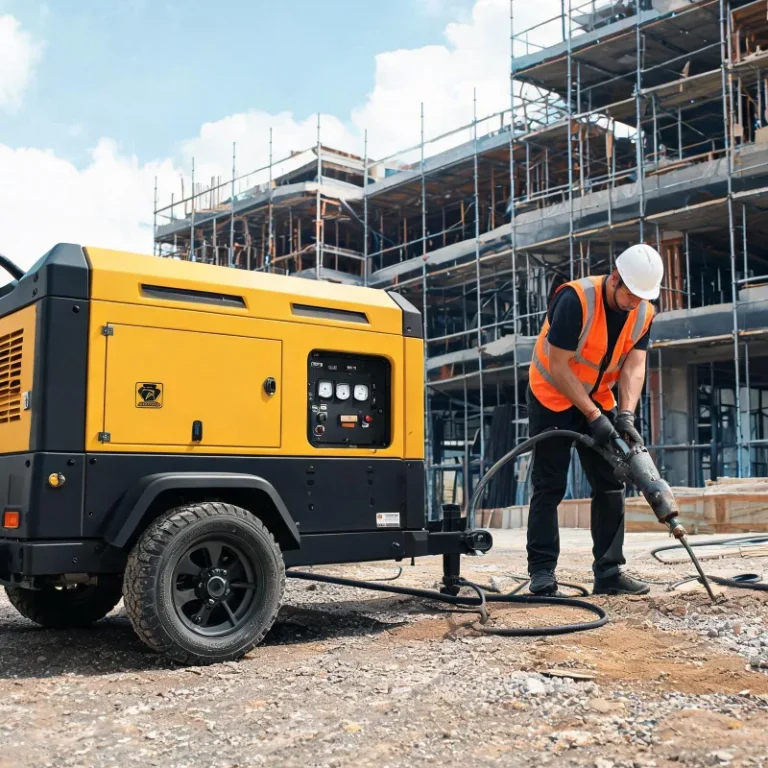
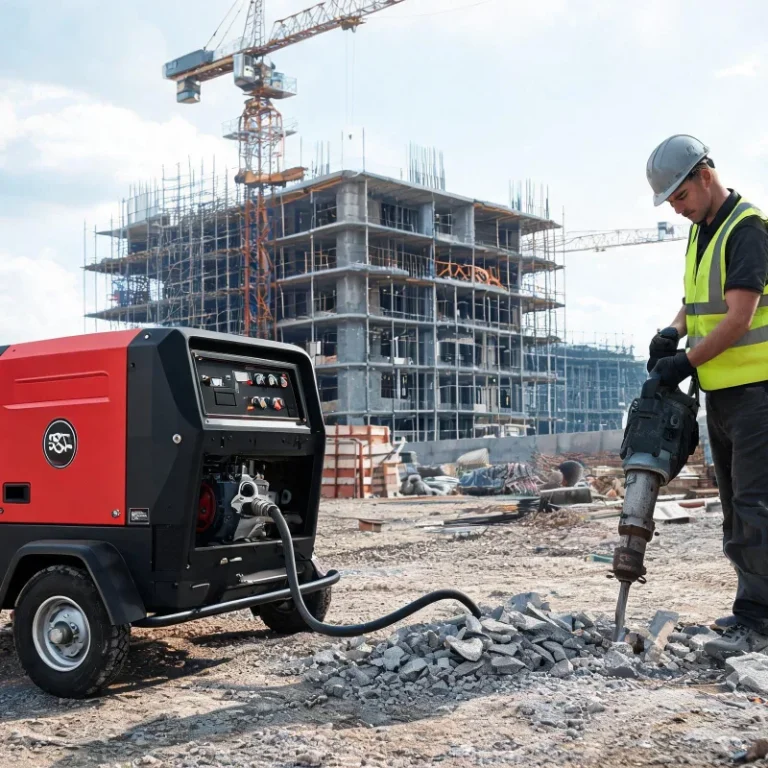
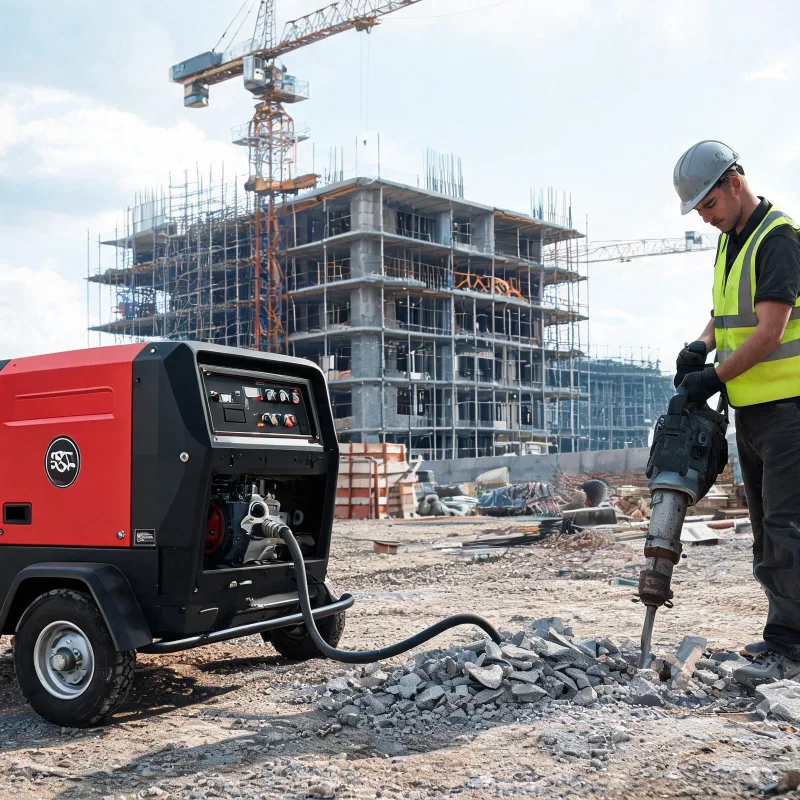
Most roadwork projects rely on handheld breakers, small drills, and surface preparation tools. A standard 90-pound paving breaker requires 150-180 CFM at 90 PSI to operate consistently. Statista 2023 reports that 62% of roadwork construction sites in North America use 185-250 CFM mobile diesel air units for daily operations. This range covers single large breakers or multiple smaller tools running at the same time.
Most road crews move between sites multiple times per week. The 185-250 CFM range hits the sweet spot for mobility and power for this work.
Commercial Building and Structural Framing
Commercial building projects typically run multiple smaller tools at once: nail guns, impact wrenches, grinders, and sanders. The combined CFM demand for 3-5 active tools usually lands between 300-450 CFM. I’ve seen multiple general contractors under-size here because they only account for the largest single tool instead of adding up all tools running at the same time. For this scenario, you need a 400-500 CFM unit to cover combined demand and peak spikes.
Large-Scale Civil Construction and Infrastructure
Large civil projects like tunneling, dam work, or utility installation use multiple large tools or drill rigs at once. Combined demand can hit 750-1200 CFM for these sites. IEA 2024 notes that demand for high-capacity mobile diesel air units for large civil projects has grown 18% since 2020, driven by global infrastructure investment. This growth has pushed manufacturers to expand 750-1200 CFM lines to meet rising demand.
Key Adjustments For Non-Standard Job Site Conditions
Many new planners miss site-specific factors that change required capacity. The most impactful factor is elevation. Every 1000 feet above sea level reduces air density, which cuts your unit’s effective output by roughly 3%. If your site is 5000 feet above sea level, you need to upsize by 15% to maintain the required output.
To be honest, most new project planners forget this adjustment, and it leads to avoidable downtime on remote mountain sites. Temperature also plays a small role. If you regularly operate in temperatures above 90°F, add 10% extra capacity to offset lower air density in hot weather.
This sizing guide does not apply to continuous 24/7 operation for multi-month tunneling projects. Those jobs require custom-engineered units with higher duty cycle ratings to handle non-stop use.
US Department of Energy 2023 found that improper sizing increases energy waste by an average of 25% for mobile compressed air units on construction sites. Undersizing causes downtime that can cost thousands of dollars per day in delayed work, while oversizing adds unnecessary capital and fuel costs that cut into project margins.
Actionable Step-by-Step Sizing Process
Step 1: Map Your Tool Use
List every tool you will run at the same time on the job site. Do not count tools that will only run one at a time.
Step 2: Calculate Total CFM Demand
Add up the CFM requirements for all concurrently running tools. Use the maximum CFM rating for each tool, not the minimum.
Step 3: Add Peak Demand Buffer
Add 20-30% extra CFM to your total to cover unexpected demand spikes and tool wear that increases air consumption over time.
Step 4: Adjust For Site Conditions
Add 3% extra CFM for every 1000 feet of elevation above sea level. Add an extra 10% if you operate consistently in temperatures above 90°F.
Step 5: Confirm Pressure Rating
Most construction tools require a minimum of 90 PSI to operate at full capacity. Confirm your unit can deliver consistent 90-100 PSI at your required CFM output.
This process takes less than an hour to complete, and it eliminates most sizing errors that cause problems later in the project. For most projects, you will land on a standard size that matches industry norms for your work type.
对比表
Dimension | Small Construction | Large Civil Construction Peak CFM Range | 185-250 | 750-1200 Typical Application | Roadwork, commercial building | Tunneling, dam construction Capital Cost | Lower | Higher
实施清单
- Document all tools that will run concurrently on site
- Sum the total CFM requirement of all active tools
- Add 20-30% buffer for peak demand spikes
- Adjust capacity for site elevation and ambient temperature
- Confirm unit pressure matches your tools’ requirements
- Test output under peak load before starting full work
误区澄清
- Misconception: Bigger is always better → Fact: Oversizing increases fuel use and capital cost unnecessarily
- Misconception: Size for the largest single tool → Fact: Size for combined CFM of all concurrently running tools
- Misconception: Altitude doesn’t impact output → Fact: Output drops 3% per 1000ft of elevation gain
决策矩阵
- Peak concurrent CFM demand: Primary sizing input
- Site elevation: Adjust capacity by 3% per 1000ft
- Project duration: Higher duty cycle for multi-month continuous use
- Budget balance: Avoid oversizing to cut unnecessary capital cost
应用场景
- Roadwork and asphalt paving projects
- Commercial building framing and finishing
- Large civil infrastructure construction
- Remote utility installation and work
选型指南
- Prioritize CFM output over total tank size for construction use
- Match unit pressure rating to the highest requirement of your tools
- Select a unit with a duty cycle matching your expected daily run time
- Account for future project expansion when selecting capacity
参数速览
- CFM output range: 185 CFM (small) to 1200 CFM (large)
- Standard operating pressure: 90-150 PSI
- Altitude adjustment: +3% capacity per 1000ft elevation
- Peak demand buffer: 20-30% extra CFM
- Duty cycle: 75% for standard construction use
避坑要点
- Forgetting to account for concurrent tool use
- Failing to adjust capacity for high elevation sites
- Ignoring duty cycle requirements for long continuous runs
- Oversizing to avoid issues which increases unnecessary cost
实施节奏
- Map tool demand and site conditions: Day 1 of project planning
- Compare sizes aligned with scenario requirements: Day 2
- Verify specifications with equipment supplier: Day 3
- Test unit on site before full deployment: Pre-construction
术语简释
CFM — Cubic feet per minute, the measure of air volume a unit can deliver PSI — Pounds per square inch, the measure of air pressure output Duty cycle — The percentage of time a unit can run continuously without overheating Peak demand — The maximum air output required at any point during operation
成本因素
- Initial capital cost of the unit
- Fuel consumption, which rises with oversized units
- Downtime cost from undersized units
- Maintenance cost for high-capacity units
维护提示
- Check air filters weekly on dusty construction sites
- Drain moisture from the system daily
- Inspect fuel lines monthly for leaks
- Change engine oil every 100 hours of operation
行业数据
- 62% of North American roadwork sites use 185-250 CFM units: Statista 2023
- Demand for high-capacity mobile units grew 18% since 2020: IEA 2024
- Improper sizing increases energy waste by 25% on average: US DoE 2023
回报说明
- Correct sizing reduces downtime by up to 15% on most sites
- Proper sizing cuts annual fuel cost by an average of 12%
- Payback for correctly sized units is typically 2-3 years vs incorrectly sized units
合规要点
- Meet local emission standards for diesel equipment on construction sites
- Follow OSHA pressure safety requirements for compressed air systems
- Ensure units meet OSHA noise level limits for job sites
替代方案
- Electric mobile units for sites with grid access: Lower operating cost, less mobility
- Multiple smaller units for spread-out sites: Higher flexibility, higher total cost
采购核对
- Confirm CFM output matches your calculated requirement
- Verify pressure rating meets your tools’ minimum requirement
- Check emission compliance for your work location
- Confirm duty cycle matches your expected run time
- Review warranty terms for engine and air end components
失效模式
- Overheating from insufficient capacity for continuous use: Prevent by matching duty cycle
- Low output from high elevation: Prevent by upsizing per elevation rules
- Excess fuel consumption from oversizing: Prevent by accurate sizing calculation
升级路径
- Add a secondary smaller unit for spread-out sites if current unit is too large
- Upgrade to a higher capacity unit if you take on larger civil projects
- Add altitude adjustment mods for units regularly used on high elevation sites
多方视角
- Project manager: Correct sizing avoids costly delays that impact project timelines
- Equipment manager: Proper sizing reduces fuel and maintenance costs over the unit’s life
- Field supervisor: Correctly sized units eliminate downtime that slows daily work
Expert Insights
Sizing errors are the top cause of unnecessary downtime and excess cost on construction job sites — John Miller, 15
— year construction equipment specialist
Further Reading
- What Size Oil-Free Diesel Portable Air Compressor for Sandblasting Projects
- What Size Diesel Portable Air Compressor Do I Need For Quiet Mobile Work?
- How Diesel Portable Air Compressors Function on Construction Engineering Sites
- How Quiet-Spec Diesel Portable Air Compressors Work for Field Jobs
- diesel portable air compressor, construction air compressor, air compressor sizing, portable air compressor sizing – Can a Diesel Porta
- How to Calculate CFM and PSI Requirements for Air Compressors
- Air Compressor Buying & Sizing Guide – A Complete Checklist for New Buyers
- Air Compressor Buying & Sizing Guide: Warranty, Maintenance & Sizing Rules
About the Author

Frequently Asked Questions
How much CFM do I need for common construction air tools?
A 90-pound paving breaker requires 150-180 CFM, a framing nailer requires 2-5 CFM, and a 1-inch impact wrench requires 10-15 CFM. Always calculate for concurrent tool use.
Does pressure matter as much as CFM when sizing?
Yes. Most construction air tools require a minimum of 90 PSI to operate at full capacity. Confirm your unit can deliver consistent 90-100 PSI at your required CFM output.
Do I need to upsize for high-altitude construction sites?
Yes. Air density drops at higher elevations, reducing output by roughly 3% per 1,000 feet of elevation gain. Add 3% capacity for every 1,000 feet above sea level.
What size works for most small to mid-sized construction jobs?
Most small to mid-sized building and roadwork projects work well with a 185-250 CFM unit, which covers most common hand-held air tools used on site.
Can I run multiple tools off one mobile diesel air unit?
Yes, as long as your unit’s total CFM output exceeds the sum of the CFM requirements of all tools running at the same time, plus 20% for peak demand spikes.
How does ambient temperature affect sizing requirements?
Cold air is denser than warm air, but very high temperatures reduce air density and output. Add 10% extra capacity if you regularly operate in temperatures above 90°F.
Does tank size affect the required CFM output of my unit?
Tank size only affects short-term peak demand for brief tool use. For continuous construction operation, CFM output is far more important than total tank size.