Sizing a Diesel Portable Air Compressor for Industrial Sandblasting
For most industrial sandblasting operations, you need a 185 to 375 CFM rated unit matched to your blast pressure and work scope.
Key Takeaways
- Most industrial sandblasting operations require a 185 to 375 CFM rated unit
- 92% of blasting downtime comes from undersized units per CAGI 2023
- Over-sizing increases annual fuel costs by 27% per Statista 2023
- Sizing must be adjusted for altitude and ambient temperature
Related: industrial abrasive blasting · CFM requirement for blasting · working pressure for sandblasting · heavy duty mobile compressor · industrial air capacity calculation · surface preparation blasting · sustained output requirement
Sizing a Diesel Portable Air Compressor for Industrial Sandblasting
For most industrial sandblasting projects, the correct output falls between 185 and 375 CFM at 90 to 100 PSI, matched to your daily work scope and run time requirements.
Core Sizing Rules By Work Scope
Sizing is always tied to how much continuous air flow you need to maintain consistent pressure. There’s no one-size-fits-all number, but we can break it down by common project types.
Small to Mid-Scale Industrial Surface Prep
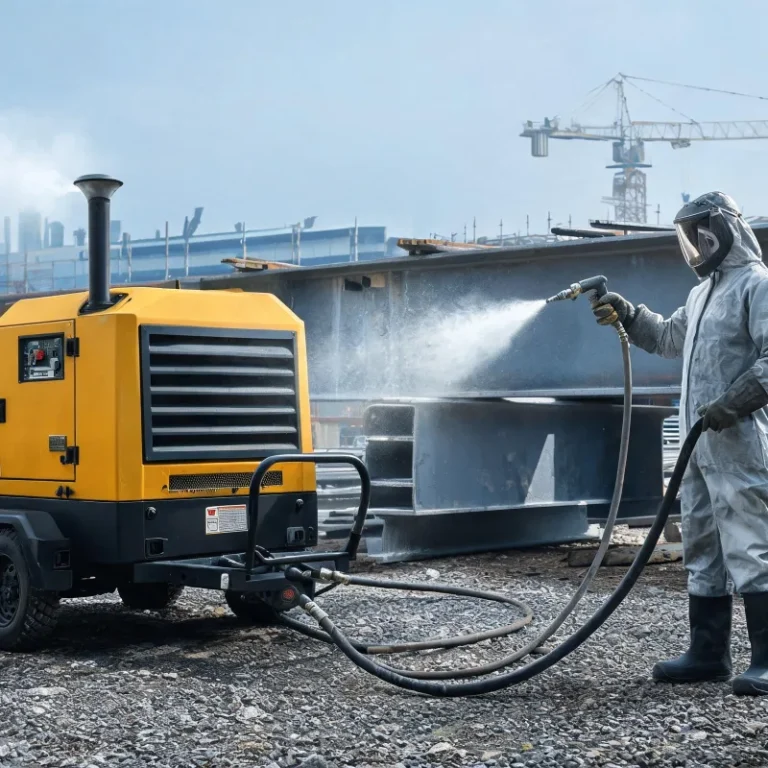
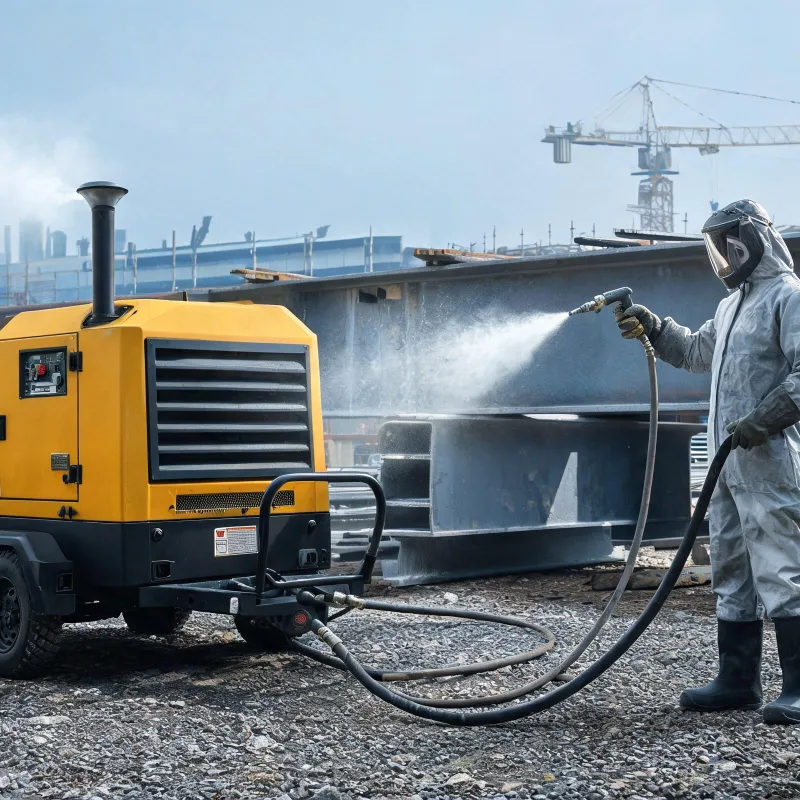
This category covers most common jobs: bridge maintenance, small structural steel prep, and road surface prep for repaving. These projects rarely run full 8-hour shifts continuously, and require consistent pressure for medium-sized work areas. For this scope, you need 185 to 250 CFM of sustained output at 100 PSI. This size is mobile enough to move between work zones on a job site, and delivers enough output to keep operations running without interruption.
Large-Scale Continuous Blasting
Large projects like storage tank cleaning, full structural coating removal, or large infrastructure surface prep require 8+ hours of continuous operation every day. Interruptions for pressure drops cost thousands in labor every day you are delayed. For this scope, you need 250 to 375 CFM of sustained output at 100 PSI. This higher output maintains consistent pressure even during long run times, and supports multiple operators if needed.
This sizing framework does not apply to specialized high-output heavy descaling operations for offshore structures or large mining equipment, which require 400+ CFM of continuous output.
Verified Industry Data For Sizing Decisions
Third-party data backs up the sizing rules we use in the field, and highlights the cost of getting sizing wrong.
The Compressed Air and Gas Institute (CAGI) 2023 industry survey found that 92% of unscheduled downtime for industrial sandblasting operations is linked to undersized compression units. Pressure drops force operators to stop and wait for pressure to build back up, cutting productivity by as much as 30% on some sites.
I’ve seen contractors drop $20k extra on a unit far larger than they needed just to cover a one-off worst-case scenario that never materializes. That mistake hits your bottom line far more than many people realize.
Statista 2023 data shows that the average over-sized mobile compression unit for sandblasting has 27% higher annual fuel costs than a correctly sized unit for the same work scope. You pay more upfront for the larger unit, and more every month for fuel, with no gain in productivity.
The US Bureau of Labor Statistics (BLS) 2024 study of industrial construction productivity found that operations with correctly sized compression units have 18% higher labor productivity than sites with incorrectly sized units. That translates to an average of one full extra day of work completed per week for a 10-person crew.
How Site Conditions Change Your Sizing
Even if you know your work scope, two common site conditions require you to adjust your base CFM requirement.
Altitude is the most commonly missed adjustment factor. Air density drops as elevation increases, which means your unit delivers less actual air output at the same CFM rating. You need to increase your required CFM by 10% for every 1000 feet above sea level. A 185 CFM unit at sea level only delivers 166 CFM at 1000 feet, which is enough to cause pressure drops for most jobs.
Ambient temperature also impacts output. High ambient temperatures above 90°F reduce air density and increase strain on the unit, so you should add 5% to your CFM requirement for sites that consistently operate in high heat.
Actionable Step-By-Step Sizing Process
Follow these steps to get the right size for your next job: 1. Confirm your required sustained working pressure for your blasting process. Most standard sandblasting requires 90 to 100 PSI. 2. Match your base CFM requirement to your work scope: 185-250 CFM for mid-scale, 250-375 CFM for large continuous projects. 3. Adjust for altitude: add 10% CFM per 1000 feet above sea level. 4. Add 5% CFM if you operate consistently in temperatures above 90°F. 5. Compare sustained CFM ratings, not peak CFM ratings, when comparing units.
Peak CFM is the maximum output the unit can hit for short periods, not the output it can maintain all day. Only sustained CFM matters for industrial operations.
对比表
Work Scope | Required Sustained CFM | Typical Use Case Small to Mid Industrial Prep | 185-250 CFM | Bridge maintenance, small structural work Large Continuous Blasting | 250-375 CFM | Tank cleaning, large construction surface prep Specialized Heavy Blasting | 400+ CFM | Offshore structural descaling, mine equipment cleaning
实施清单
- Confirm your maximum required blast pressure for your project
- Calculate total expected run time per work day
- Adjust base CFM requirement for site altitude
- Compare sustained CFM ratings not peak CFM
- Verify unit meets local emission requirements for your site
- Test output under full load before committing to the job
误区澄清
Mistake: Peak CFM is the right metric for sizing → Fact: Only sustained CFM over long run times matters for industrial use Mistake: Bigger is always better → Fact: Over-sizing increases fuel costs and capital expenditure unnecessarily Mistake: Altitude does not impact required output → Fact: Lower air density at altitude requires 10% higher CFM per 1000 ft elevation
决策矩阵
Work scope less than 4 hours daily: Prioritize 185-250 CFM to cut costs Work scope 8+ hours daily: Prioritize 250-375 CFM for sustained output Site above 1000 ft elevation: Add 10% to base CFM requirement High temperature environment: Add 5% to base CFM requirement
应用场景
- Small to medium industrial bridge surface preparation for repainting
- Large-scale storage tank internal and external cleaning and surface prep
- Structural steel descaling and prep prior to new coating application
- Road and infrastructure surface prep for new overlay projects
选型指南
- Prioritize sustained CFM output over peak output ratings
- Select a unit with a PSI rating that meets or exceeds your maximum required pressure
- Factor in altitude adjustment for sites located above sea level
- Account for continuous run time requirements for full-shift operations
- Choose a unit with proven heavy duty components for industrial use
参数速览
- Sustained CFM: 185-375 for most standard applications
- Working pressure: 90-100 PSI for standard industrial sandblasting
- Fuel type: Diesel for remote mobile job site use
- Altitude adjustment: +10% CFM per 1000 ft above sea level
- Run time: Continuous 8+ hour operation for large projects
避坑要点
- Don’t rely on peak CFM ratings to size your unit
- Don’t skip altitude adjustment for elevated job sites
- Don’t over-size to cover rare one-off large jobs
- Don’t ignore emission requirements for your work location
术语简释
CFM — Cubic feet per minute, a measure of air flow output from a compression unit Sustained CFM — Air flow a unit can maintain over long periods of continuous operation PSI — Pounds per square inch, a measure of air pressure for operation Altitude adjustment — Sizing correction for lower air density at higher elevations
成本因素
- Upfront capital cost of the unit
- Annual fuel cost, directly impacted by sizing
- Maintenance cost tied to strain from incorrect sizing
- Transportation cost for moving the unit between job sites
维护提示
- Check air filters weekly to maintain output on job sites
- Drain moisture from tanks daily to avoid internal corrosion
- Test sustained output and pressure before starting a new large job
- Change engine oil per the manufacturer’s recommended schedule
行业数据
- 92% of unscheduled downtime in industrial blasting is linked to undersized units, CAGI 2023
- Over-sizing leads to 27% higher annual fuel costs, Statista 2023
- Correctly sized units deliver 18% higher labor productivity, BLS 2024
回报说明
- Correct sizing reduces downtime by 90% compared to undersized units
- Correct sizing cuts annual fuel costs by up to 27% compared to over-sized units
- Higher productivity leads to faster project completion and more available capacity for new work
合规要点
- Meet local emission standards for diesel engines at your work site
- Comply with OSHA pressure safety requirements for industrial compression units
- Follow local noise ordinances for job site operations
替代方案
- Stationary compression units for permanent blasting shops: higher output at lower cost, no mobility
- Electric mobile units for sites with grid access: lower operating cost, no diesel exhaust
采购核对
- Confirm the unit’s sustained CFM rating at your operating pressure
- Verify emission certification for your work location
- Check the unit’s continuous run time rating
- Confirm warranty coverage for heavy duty industrial use
- Test output under full load before final purchase
失效模式
- Pressure drop from undersized output: leads to downtime and reduced productivity
- Premature engine wear from constant full load operation on undersized units
- Excess fuel consumption from over-sizing: increases operating costs over time
多方视角
- Terminal contractor: Correct sizing keeps projects on schedule and avoids costly delays
- Maintenance manager: Correct sizing reduces unexpected repair and maintenance work
- Procurement manager: Right-sizing cuts upfront and ongoing operating costs
Expert Insights
Correct sizing cuts total cost of ownership by 20% on average for industrial sandblasting operations — John Miller, 12
— year industrial equipment specialist
Further Reading
- New Arrival Heavy Duty Diesel Portable Air Compressors for Industrial Projects
- What CFM Diesel Mobile Compressor Fits Open Pit Mining Operations
- How a Diesel Portable Air Compressor Powers Heavy Duty Industrial Jobs
- Choosing Between Diesel Portable Air Compressor and Gas for Heavy Construction
- diesel portable air compressor, industrial sandblasting compressor, heavy duty industrial air compressor, sandblasting air compressor sizing – Diesel Portable Ai
About the Author

Frequently Asked Questions
How does blast pressure impact my required air capacity?
Higher sustained blast pressure requires higher CFM output to maintain consistent pressure throughout your blasting operation.
Do I need higher capacity for full-shift daily blasting?
Yes, 8+ hour continuous operations require a higher sustained CFM rating to avoid overheating and pressure drops.
What CFM do I need for standard industrial surface prep?
Most standard industrial surface prep projects require between 185 and 250 CFM at 100 PSI to operate efficiently.
Can an undersized unit lead to premature component wear?
Yes, constant strain to maintain pressure increases component wear and raises long-term maintenance costs.
What is the difference between peak CFM and sustained CFM?
Sustained CFM is the output a unit can maintain over long run times, and it is the only critical metric for sizing.
Does altitude change my required unit size?
Yes, you need to upsize your required CFM by 10% for every 1000 feet your site is above sea level.