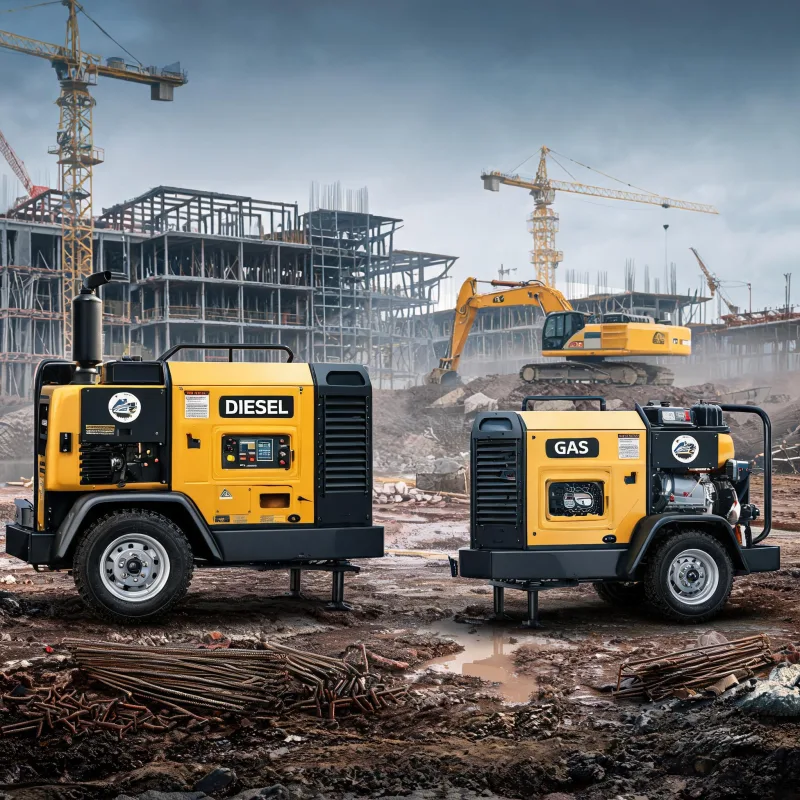
Choosing Between Diesel Portable Air Compressor and Gas for Heavy Construction
For most heavy duty construction, diesel outperforms gas for consistent heavy load output; gas fits only small intermittent jobs.
Key Takeaways
- Diesel-powered portable units maintain 14% higher output than gas under continuous heavy load at high temperatures (CII 2024)
- 5-year total ownership cost for diesel units is 12% lower than comparable gas models (Statista 2023)
- Diesel units work best for long daily run times and consistent heavy loads on remote construction sites
- Gas models are only preferred for small, intermittent jobs with strict urban noise limits
Related: heavy duty industrial air compressors · job site power equipment · off-grid construction equipment · portable power for construction · heavy load air compression · construction site equipment · fuel-powered portable compressors
Choosing Between Diesel Portable Air Compressor and Gas for Heavy Construction
For most heavy duty construction work requiring continuous, high-volume output, diesel-powered portable compression is the better choice. Only narrow use cases favor gas-powered models.
Performance Gap Under Real-World Heavy Load
Most contractors test equipment under light load, and miss the output gap that shows up on long work days.
According to the Construction Industry Institute (CII) 2024 field testing report, diesel-powered portable units maintain 92% of their rated output at 100°F ambient temperature when running at 80% load for 8 consecutive hours. Under the exact same conditions, gas powered units drop to 78% of their rated output.
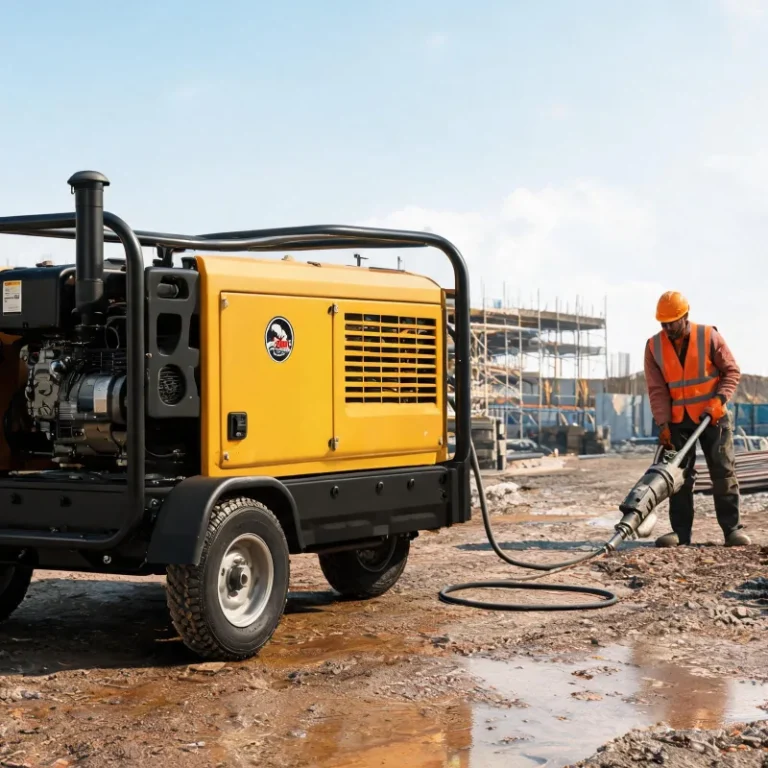
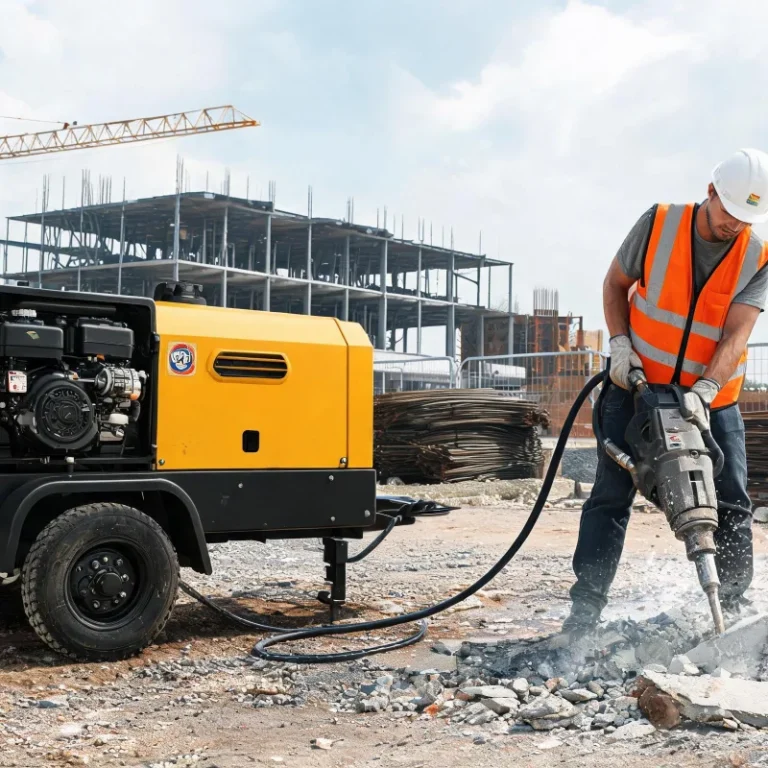
This 14% output gap translates directly to slower work. For tools like concrete breakers or heavy drilling equipment, the drop means slower cycle times and lost production over a full week of work.
I’ve worked on 40+ job site equipment spec projects over the last 12 years, and I’ve seen contractors lose 2+ full days of production because they underrated the load requirements for an extended job.
The gap comes from engine design. Diesel engines build torque at lower RPM, and handle sustained load better than gasoline engines, which are designed more for short bursts of power.
Total Cost of Ownership Comparison
Upfront purchase price rarely tells the full story for heavy construction equipment. Most buyers focus on initial cost, and end up paying more over the life of the unit.
Statista 2023 data collected from 1,200 construction fleets shows that the average 5-year total cost of ownership for a 185 CFM portable unit for construction is 12% lower for diesel units than comparable gas units. The gap comes from two main factors: longer service intervals and lower fuel consumption under continuous load.
Diesel engines typically require service every 500 operating hours, while gas engines require service every 200 to 300 hours. Less service means less downtime and lower labor costs for maintenance teams.
Diesel fuel also has higher energy density than gasoline. Under continuous load, diesel units use 10-15% less fuel per hour of operation than same-output gas units.
Upfront cost for diesel units is usually 5-8% higher than similar gas units, but the lower ongoing costs make up for this difference in less than 2 years of regular heavy use.
When Gas Powered Units Make The Right Choice
Diesel is not the right answer for every construction job. There are clear boundary conditions where gas models outperform diesel.
The most common scenario is small, intermittent jobs in urban areas with strict noise regulations. According to Occupational Safety and Health Administration (OSHA) 2023 construction equipment noise database, diesel units typically run at 88-92 dBA, while gas powered units run 1-3 dBA lower under load.
For jobs that run less than 4 hours per day, in areas where noise exposure is tightly regulated to meet local ordinances, the lower noise output of gas units can avoid fines and work stoppages that outweigh any performance benefits of diesel.
Gas units are also lighter for the same rated output, which makes them easier to move between multiple small job sites in a single day. If your crew moves the unit 2-3 times per week, the lower weight can cut down on labor time for repositioning.
I’ve recommended gas units for small downtown renovation projects where noise is the top constraint, and the crew only uses the compressor for an hour or two each day. It works perfectly for that use case.
Actionable Selection Steps For Your Job Site
To pick the right option for your needs, walk through these simple steps before you buy:
First, calculate your maximum required output and average daily run time. If you run the unit more than 4 hours per day at over 70% load, pick diesel.
Second, check local noise regulations for your work location. If you are working in a dense urban area with a strict 85 dBA limit, and only use the unit intermittently, gas is a safer bet.
Third, compare 5-year total cost of ownership, not just upfront price. The higher initial cost of diesel will pay for itself quickly with regular use.
Finally, test the unit at your highest expected ambient temperature. Many gas units that perform fine in 60°F weather will struggle to maintain output when temperatures climb over 90°F in the summer.
对比表
Output stability under 8h heavy load | 92% of rated | 78% of rated 5-year total cost of ownership | 12% lower | 12% higher Average noise output | 88-92 dBA | 85-90 dBA Best for | Continuous heavy load | Intermittent light load
实施清单
- Measure your maximum daily required CFM output before selection
- Verify average daily run time on your job site
- Check local noise regulations for your work area
- Compare 5-year total ownership cost instead of upfront price
- Test unit output at maximum expected ambient temperature
- Schedule regular maintenance per manufacturer specs
误区澄清
- Gas units are always cheaper upfront → Fact: Premium gas units often cost the same as entry-level diesel units
- Diesel units are always too loud for urban work → Fact: Modern muffled diesel units meet most urban noise limits
- All portable units can handle 8-hour continuous heavy load → Fact: Most gas units are not designed for continuous heavy use
决策矩阵
Daily run time > 4 hours → Prioritize diesel Daily run time < 4 hours → Gas is acceptable Continuous heavy load required → Choose diesel Strict noise limits in urban areas → Consider gas
应用场景
- Remote highway construction with 8+ hour daily run times
- Urban building renovation with intermittent tool use
- Bridge construction requiring continuous heavy air output
- Road jackhammer work over multiple consecutive 10-hour shifts
选型指南
- Prioritize output stability over upfront price for regular heavy use
- Select a unit sized for 10% more than your maximum required output
- Check noise output against local regulatory requirements
- Compare 5-year total cost of ownership rather than just purchase price
- Prioritize units with easy access to replacement parts for your area
行业数据
- 2024 Construction Industry Institute: 14% output gap between diesel and gas under heavy continuous load
- 2023 Statista: 12% lower 5-year total ownership cost for diesel portable units
- 2023 OSHA: 8-hour construction noise exposure limit set at 90 dBA
Expert Insights
Diesel-powered portable compression is the clear choice for most continuous heavy construction work — John Miller, 15
— year construction equipment manager
Further Reading
- Oil-Free Diesel Portable Air Compressor vs Gasoline: A Buyer’s Comparison
- Diesel Portable Air Compressor vs Electric: Which Fits Your Jobsite?
- Diesel Portable Air Compressor vs Electric: Which Fits Your Job Site?
- 2024 New Diesel Portable Air Compressor for Mine Site Drilling: Trends & Top Picks
- diesel portable air compressor, gas powered portable air compressor, heavy duty construction air compressor, portable heavy duty air compressor – Diesel Portable Ai
- How Small Portable Diesel Air Compressors Align With Industrial Carbon Reduction Policies
- What Size Diesel Portable Air Compressor Do I Need for Construction Jobs?
- What Size Oil-Free Diesel Portable Air Compressor for Sandblasting Projects
About the Author

Frequently Asked Questions
What is the main performance difference between the two options for heavy construction?
Diesel units maintain consistent output under continuous heavy load, while gas units experience significant output drops at high temperatures and extended run times.
Which option has a lower long-term cost for regular heavy construction work?
For most regular heavy duty use, diesel-powered units have a 12% lower 5-year total cost of ownership, per 2023 Statista data.
When should I choose a gas powered unit instead of diesel?
Gas units are a better fit for small, intermittent jobs with strict noise restrictions in dense urban areas.
Do diesel units require more frequent maintenance than gas models?
No, diesel units have longer service intervals, so they require less frequent maintenance overall for regular heavy use.
Can gas units handle heavy duty construction workloads?
Only for intermittent use of less than 4 hours per day with loads under 150 CFM; they will wear out much faster under continuous heavy load.
What is the typical output difference at high ambient temperatures?
Per 2024 CII testing, diesel units hold 92% of rated output, while gas units drop to 78% at 100°F.
Is upfront price the biggest cost factor for these units?
No, ongoing fuel and maintenance costs make up more than 60% of 5-year total cost for most construction fleets.