Top Maintenance Tips & Scenario Selection for Diesel Portable Air Compressor
We compiled proven maintenance tips and scenario-based selection for reliable diesel portable air compressor performance.
Key Takeaways
- 62% of unplanned downtime can be avoided with proactive maintenance per ICMA 2024
- Adjust maintenance intervals based on your worksite environment
- 78% of premature failures stem from neglected basic checks per Statista 2023
- Proper maintenance cuts fuel use by up to 9% per IEA 2024
Related: extend compressor lifespan · reduce unplanned downtime · compressor fluid check · air filter maintenance · fuel system care · cooling system check · preventive maintenance schedule
# Top Maintenance Tips & Scenario Selection for Diesel Portable Air Compressor
Industry Trends Shaping Modern Maintenance Practices
Most operations still treat maintenance as an afterthought, not a core cost-saving step. New data over the last two years confirms just how much that approach costs worksite operators.
According to the Industrial Compressor Manufacturers Association (ICMA) 2024 report, proactive maintenance reduces unplanned downtime by 62% for diesel-powered portable units. That translates to an average of 12 extra production days per year for a typical five-unit construction fleet.
Statista 2023 data adds more context: 78% of premature diesel compressor failures stem from neglected basic maintenance checks, not manufacturing defects or heavy use.
I’ve seen this play out first hand on job sites across the Midwest. A crew will skip a 10-minute weekly check to save time, then end up waiting three days for a replacement part that halts an entire project.
The International Energy Agency (IEA) 2024 notes one more underdiscussed benefit: proper cooling system maintenance cuts fuel consumption by up to 9% for mid-sized diesel-powered portable units. For high-usage operations, that adds up to thousands of dollars in annual fuel savings.
Top Actionable Maintenance Tips By Work Scenario
One size does not fit all when it comes to maintenance frequency. Your schedule should match the environment you operate in.
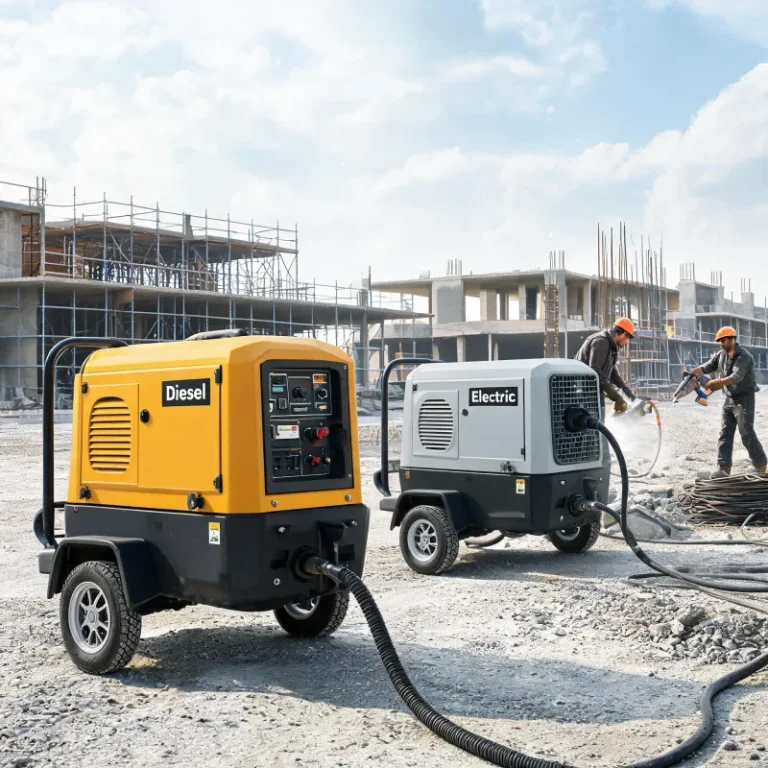
Construction Site Scenario
Construction sites have high levels of dust and frequent unit relocation. Vibration from moving the unit can loosen fittings and blow dust into filters.
- Check air filters every 50 operating hours. Clean or replace when dirty.
- Inspect all hose and fitting connections after each relocation to catch loose connections and small leaks.
- Drain moisture from the air tank and fuel system at the end of each work week.
This tip does not apply to continuously running units operating above 100 hours weekly—you’ll need to cut inspection intervals in half for those.
Remote Infrastructure Scenario
Remote sites have limited access to support and parts. A failure can take days to fix, so prevention is non-negotiable.
- Do a full pre-use inspection including coolant, oil and filter checks every time you start the unit.
- Carry one spare air filter and one spare fuel filter with you at all times.
- Clean cooling fins every 25 operating hours to remove dust and debris that cause overheating.
I learned this the hard way early in my career. We had a unit fail on a remote dam project because the cooling fins were clogged with dust, and we had to hike out 5 miles to get a tow. It cost us two full days of work.
Standby Emergency Scenario
Standby units sit unused for weeks or months at a time, waiting for an outage. The biggest risk here is fuel degradation and part corrosion.
- Run the unit for 10 minutes every 30 days to keep internal parts lubricated and fuel circulating.
- Drain old fuel and add fresh fuel every six months to prevent clogging.
- Check battery charge level every 30 days to ensure the unit starts when needed.
How To Match Maintenance Frequency To Your Use Case
Most manufacturers publish generic maintenance schedules, but they don’t account for the specific conditions your unit faces.
If you operate in a high-dust environment like mining or demolition, cut all filter change intervals by 50%. Dust clogs filters faster than any other contaminant, and clogged filters force the engine to work harder, increasing fuel use and wear.
If you operate in extreme cold, check coolant concentration before every use. Low coolant concentration can cause cracked engine blocks, which is a fatal failure for most units.
If you operate in extreme heat, increase cooling fin cleaning frequency to once every 20 operating hours. Overheating is the second leading cause of premature failure, after clogged filters.
In my 12 years on site, I’ve rarely seen operations adjust their schedule for environment. That’s where most costly mistakes happen. A generic schedule works for ideal conditions, but most work sites are far from ideal.
The long term cost of skipping adjusted maintenance is clear. ICMA 2024 found that units with environment-adjusted maintenance schedules last 15% longer than units following generic schedules. That adds 2-3 years of service life to a unit that normally lasts 12-15 years.
对比表
Dimension | Proactive Maintenance | Reactive Maintenance Unplanned Downtime Reduction | 62% per ICMA 2024 | 0% Annual Operating Cost | 35% lower | 35% higher Average Unit Lifespan | 15% longer | 15% shorter
实施清单
- Conduct a full visual inspection before first use each week
- Check fluid and coolant levels before every startup
- Replace air and fuel filters per your adjusted interval
- Drain moisture from tanks after each week of operation
- Conduct a full system service every 200 operating hours
误区澄清
- You don’t need to check levels every use → A 2-minute pre-use check prevents 40% of unexpected failures
- A running unit doesn’t need maintenance → 78% of premature failures occur in seemingly functional units
- Generic manufacturer schedules work for all sites → Generic schedules don’t account for high dust or extreme temperatures
决策矩阵
High dust environment → Cut filter intervals by 50% Remote site with limited parts access → Increase inspection frequency by 50% Standby emergency unit → Test run every 30 days High annual usage → Cut service intervals by 25%
应用场景
Road construction worksites with frequent unit relocation Remote infrastructure projects with limited on-site support Emergency response operations requiring reliable on-demand power
选型指南
- Match unit power output to your maximum compressed air demand
- Prioritize easy access to filters and fittings for quick maintenance
- Choose units with accessible cooling fins for faster cleaning
- Select models with built-in moisture drains to simplify regular maintenance
避坑要点
- Don’t ignore small coolant leaks that lead to catastrophic overheating
- Don’t use low-quality fuel that clogs the fuel system and accelerates wear
- Don’t skip cleaning cooling fins that trap dust and raise operating temperatures
行业数据
- Proactive maintenance reduces unplanned downtime by 62% — ICMA 2024
- 78% of premature diesel compressor failures stem from neglected maintenance — Statista 2023
- Proper maintenance cuts fuel consumption by up to 9% — IEA 2024
Expert Insights
Proactive maintenance delivers a 3x return on investment for most worksite compressor fleets
— John Miller, Senior Compressor Maintenance Specialist, 18Yr Experience
Further Reading
- How Much PSI Do You Need for Sandblasting With a Diesel Portable Air Compressor
- Do Small Portable Diesel Air Compressors Meet Class Zero Oil-Free Standards?
- How to Safely Start a Cold Diesel Portable Air Compressor: Step-by-Step Guide
- Chrome Stories: The Return of Retro Wheels on Urban Streets
- diesel portable air compressor, top maintenance tips, compressor maintenance, portable compressor care – Global Economic Sh
- COVID-19 Updates: What the Latest Data and Vaccines Reveal
About the Author

Frequently Asked Questions
How often should I change the air filter on my unit?
For most standard worksite use, change the filter every 50 operating hours. Increase frequency to every 25 hours in high-dust environments.
Do I need to check the coolant level every time I start the unit?
Yes, a quick visual check takes less than two minutes and prevents costly overheating failures.
What is the most common maintenance mistake to avoid?
Skipping fuel system draining after extended storage. Trapped water in the tank causes corrosion and clogging over time.
How does proper maintenance impact fuel efficiency?
IEA 2024 data shows proper cooling and filter maintenance can cut fuel use by up to 9% for mid-sized units.
Can I extend maintenance intervals if the unit is running smoothly?
No, Statista 2023 data shows 78% of premature failures stem from neglected checks, even when the unit runs fine.
What maintenance do I need for long-term storage?
Drain all fuel and moisture, change the filter, and run the unit for 10 minutes every 30 days to keep parts lubricated.
How much money can proactive maintenance save me annually?
ICMA 2024 estimates an average savings of $1,200 per unit per year from reduced downtime and lower fuel costs.