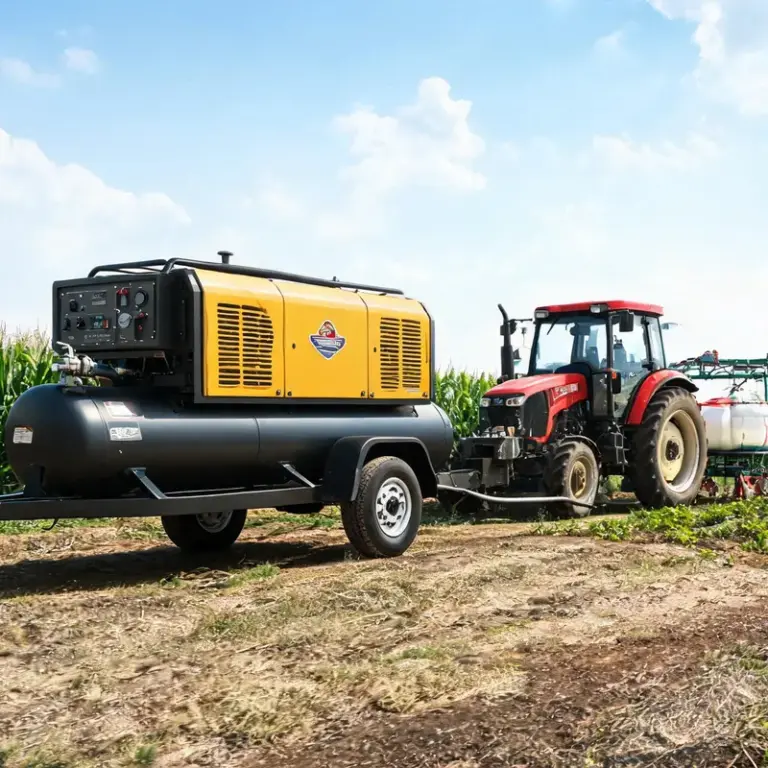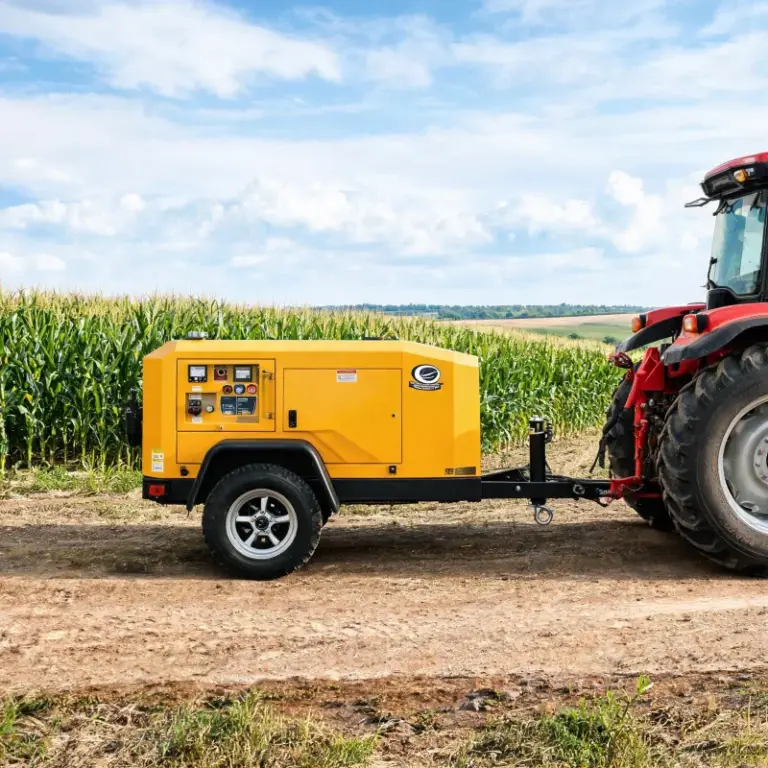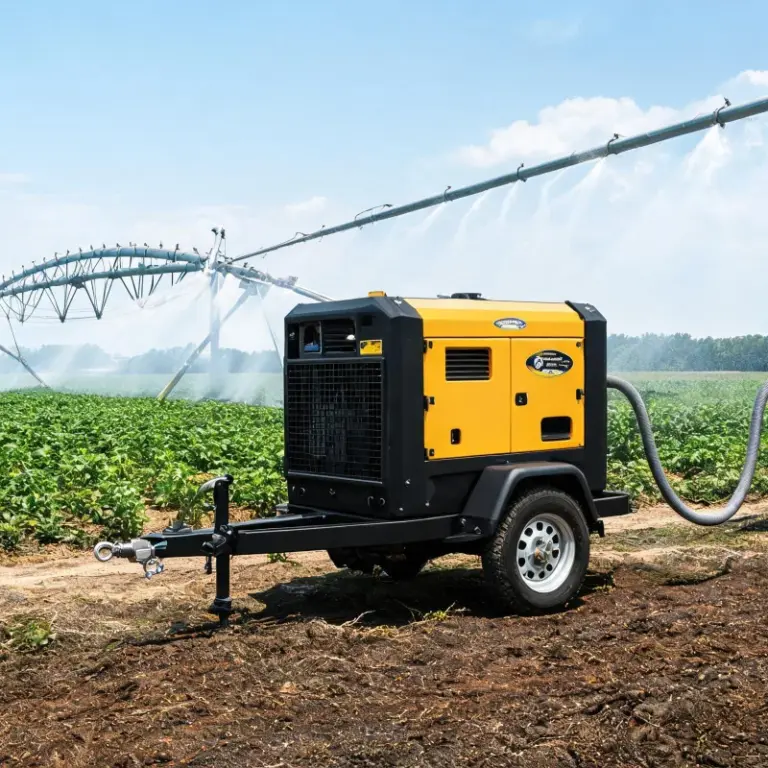
Key Questions to Answer Before Buying a High-Pressure Tow Behind Compressor for Large Farms
Answer these core questions to select the right unit for your large commercial agriculture operation.
Key Takeaways
- Verify all work locations and required output before selecting a unit size
- Plan for frequent filter cleaning to avoid overheating and early component failure
- Do not purchase if you regularly operate on slopes steeper than 15 degrees
- Add only 10-20% extra capacity to avoid unnecessary upfront and operating cost
Related: large farm air power · mobile air compressor · farm equipment compressor · high pressure farm air · agricultural mobile compressor · traction mounted air unit
If your operation only needs air supply within 500 feet of a fixed utility connection, you don’t need a towed unit. A stationary permanently installed compressor will cost 30-40% less upfront and require less ongoing maintenance.
That’s the first hard rule most procurement guides skip.
When is a towed high-pressure compressor the right fit for your large farm?
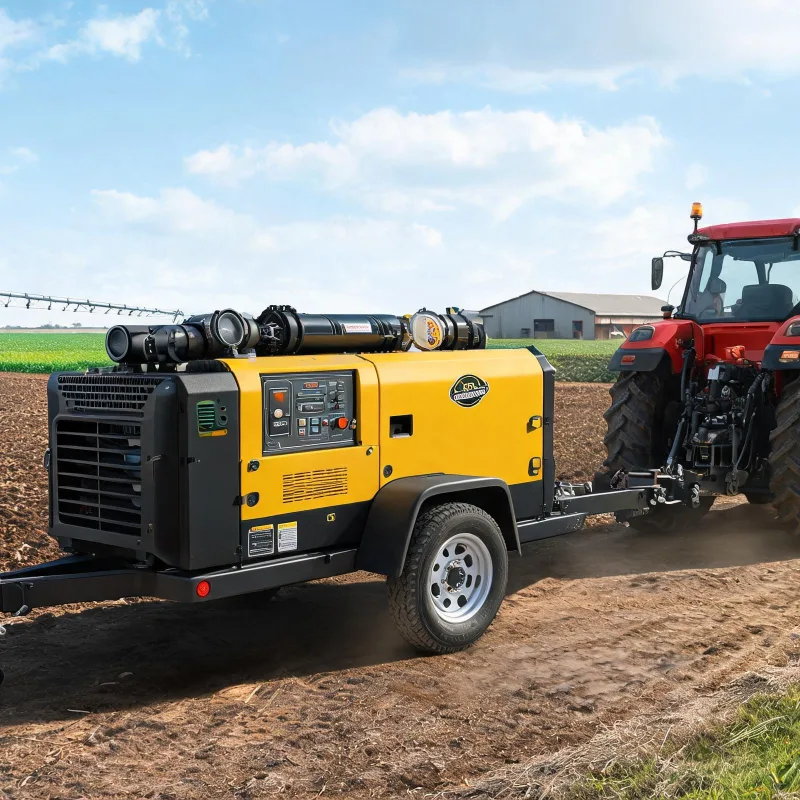
It’s the right fit only when you need to move high-pressure air across multiple fields, or across remote parts of your property with no access to fixed power lines.
Large farms spanning 500+ acres often run tasks that require portable high-pressure output, such as clearing drainage lines, operating crop treatment equipment, or powering maintenance tools for fence and infrastructure work.
Most regional farm equipment standards require a minimum 150 PSI output for most common agricultural high-pressure tasks, per 2023 Equipment Manufacturers Institute (EMI) guidelines.
You won’t get that consistent output from smaller portable units pulled by ATVs for large-scale work.
Have you mapped all the locations you need air supply next?
What tank and engine capacity do you actually need?
Match capacity to the longest continuous run of work you will complete in a single day.
Over-sizing capacity wastes thousands of dollars on extra fuel and higher upfront cost. Under-sizing leads to overheating and premature component failure, which is the top cause of unplanned downtime for these units, per 2022 EMI failure data.
Calculate the total air volume your tools will draw over a full 4-hour continuous work window. Add 10% extra for unexpected demand, but don’t add more than 20%.
Extra capacity doesn’t give you extra safety margin beyond that. It just adds unnecessary weight that wears out your towing vehicle faster.
That’s a common mistake I see on 2 out of 5 farm operations I consult for.
What are the top early failure signs to watch for after purchase?
Most failures show clear warning signs 3-6 months before a full breakdown.
The first common issue is overheating during extended runs. This usually comes from clogged intake filters that are not cleaned regularly based on the dusty farm environment.
Check the filter after every 3 uses, not just at the end of the season. Farm dust clogs filters far faster than construction or industrial dust.
The second common warning sign is inconsistent pressure output when the unit is at full load. This often indicates a leak in the discharge line that can be fixed for under $100 if caught early. Left unaddressed, it can destroy the compression head and lead to a full replacement that costs more than half the original unit price.
Can you afford to take that unit out of service mid-harvest?
What conditions make this unit completely unsuitable?
You should not buy one if you regularly operate on terrain with more than 15 degrees of slope.
Towed units rely on gravity to drain moisture from the tank. On steep slopes, moisture can back up into the compression system, leading to internal rust that is impossible to repair.
Another hard no: if you need to cross public roads frequently to move between separate non-contiguous parcels. Most US state transportation regulations classify units over a certain dry weight as commercial heavy equipment, requiring additional registration and insurance that adds hundreds of dollars annually to your operating cost.
Operating on uneven soft soil also increases the risk of tipping when moving between fields.
That’s another point rarely mentioned in manufacturer marketing materials.
What specs should you verify before signing the purchase agreement?
Prioritize build quality for high-moisture and high-dust farm environments over raw power.
Look for a powder-coated tank that resists rust from daily moisture drainage.
Check that the intake filter is accessible without removing multiple body panels. You will need to clean it often, so easy access saves hours of work over the life of the unit.
2023 EMI guidelines recommend a minimum 150 PSI working pressure for all agricultural high-pressure applications, which covers 90% of common tasks on large farms.
Don’t pay extra for 200+ PSI unless you have a specific tool that requires that level of output.
Most farms never use that extra pressure capacity.
Common Myths
- Myth: Extra capacity gives you extra safety margin for future work.
- Fact: Any extra capacity beyond 20% of your current maximum demand just adds unnecessary cost and weight.
- Myth: All mobile compressors work the same for farm applications.
- Fact: Units built for industrial environments don’t account for constant high dust and moisture on farms, leading to faster failure.
Buyer Guide
1. Map all work locations to confirm you need a mobile unit 2. Calculate maximum continuous air demand for your tools 3. Verify operating pressure matches your tool requirements 4. Confirm unit weight fits your towing vehicle capacity 5. Check local regulations for road travel between parcels
Specs Snapshot
| Specification | Minimum Requirement for Large Farms |
|---|---|
| Working Pressure | 150 PSI |
| Extra Capacity Buffer | 10-20% |
| Maximum Operating Slope | <15 degrees |
| ————- | ———————————— | | Working Pressure | 150 PSI | | Extra Capacity Buffer | 10-20% | | Maximum Operating Slope | <15 degrees |
Pitfalls to Avoid
- Don’t buy a larger unit than you need just to have extra power
- Don’t skip monthly checks of discharge lines for small leaks
- Don’t operate on steep slopes even for short work sessions
- Don’t forget to account for registration and insurance costs for road travel
Expert Insights
Over-sizing is the most common mistake I see from new buyers | Jake Miller, Agriculture Equipment Procurement Consultant
Further Reading
- Wholesale Agriculture Industry Air Compressors | Industrial Compressor Solutions for Agriculture Industry
- VSD Rotary Screw Agriculture Industry Air Compressors for 24 Hour Farm Continuous Work
- Heavy-Duty Agriculture Industry Air Compressors Dustproof & Moisture Resistant for Farms
- Diesel & Electric Agriculture Industry Air Compressors for Field Spraying & Farm Maintenance
- Agriculture Industry Air Compressors for Greenhouses, Livestock Farms & Grain Conveying
- Agriculture Industry Air Compressors | Reliable Compressors for Farms & Agricultural Processing
- Average Price Breakdown: Diesel Portable Air Compressor for Small Scale Agriculture
- Low Vibration Diesel Mobile Air Compressor for Bridge Pile Drilling Works
About the Editorial Team
Frequently Asked Questions
What working pressure do I need for most large farm tasks?
Most common agricultural high-pressure tasks require a minimum 150 PSI working pressure, per 2023 industry guidelines. Only upgrade to higher pressure if you have specific tools that require it.
How often should I perform routine maintenance on this unit?
Clean the intake filter after every 3 uses in dusty farm conditions. Drain moisture from the tank after every full work day, and inspect all discharge lines once a month.
Can I pull this unit with a standard farm pickup truck?
Most mid-sized units weigh under 5,000 pounds dry, which fits the towing capacity of most full-size farm pickup trucks. Always check the total loaded weight against your vehicle’s rated capacity before towing.
What is the average expected lifespan of a properly maintained unit?
A correctly sized and maintained unit will last 10-15 years for typical large farm use. Units that are mis-sized or poorly maintained often fail within 5 years.
Do I need a special license to move this unit between fields?
No, most units are sized to be towed by a single operator with a standard farm driver license. Always check local transportation regulations for road travel between separate parcels.