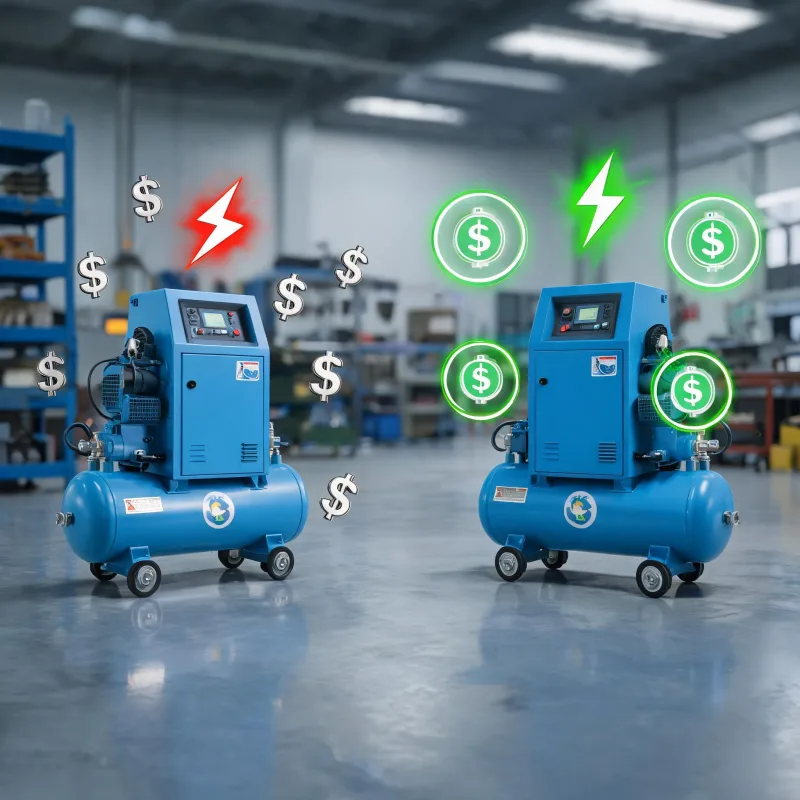
Air Compressor Buying & Sizing Guide: Expert Tips to Save Energy & Money
Expert Tips to Size and Buy an Air Compressor to Save Energy & Money
Key Takeaways
- Over 30% of compressed air energy is wasted from incorrect sizing per DOE 2023
- Properly sized VSD units cut energy use by 22-35% per IEA 2024
- Add 20% extra CFM for most intermittent workshop use
- Prioritize lifetime operating cost over upfront purchase price
- Annual leak inspections prevent thousands in wasted energy costs
Related: how to size an air compressor · best energy efficient air compressor for workshop · air compressor operating cost · air compressor capacity calculation · compressed air energy waste
Key Insights
- Over 30% of compressed air energy is wasted from incorrect sizing (DOE 2023)
- Properly sized VSD units cut energy use by 22-35% versus fixed-speed models (IEA 2024)
- Oversized air compressors can double annual operating costs for the same output
- The 20% extra capacity rule works for most workshops, not 24/7 industrial use
Buying an incorrectly sized air compressor costs you thousands over the unit’s lifetime. Right sizing cuts annual energy use by up to 50% for most small to mid-sized applications.
How Sizing Impacts Energy and Long-Term Cost
Most buyers only focus on upfront purchase price when shopping for a new unit. This ignores the fact that operating costs make up 70-80% of total ownership cost over a 10-year lifespan.
The U.S. Department of Energy (DOE) 2023 data confirms compressed air systems account for 10-30% of total industrial electricity use across the U.S., and 30% of that energy is wasted through incorrect sizing or unaddressed leaks.
The International Energy Agency (IEA) 2024 report adds that properly sized variable speed drive (VSD) air compressors reduce energy consumption by 22-35% compared to same-output fixed-speed units running variable load.
Statista 2023 data puts the average annual operating cost for a 10HP industrial air compressor at $1,200 in the U.S. Oversized units push that annual cost up to $2,100, a 75% increase for no added benefit.
I’ve seen a 15HP small workshop owner replace an oversized 25HP unit and cut their annual electric bill by $800 in the first year. This isn’t a theoretical gain—it’s accessible savings for most users.
How to Calculate Correct Sizing
Step 1: Calculate Total Required CFM
List the CFM requirement for every tool you will run at the same time. Add those numbers together to get your base required CFM.
Step 2: Add a Safety Margin
For most intermittent workshop use, add 20% extra CFM to your base total to account for fluctuations and future tool additions.
This 20% rule does not apply to 24/7 continuous industrial operations. Those applications require a 30-40% safety margin and a professional on-site load assessment.
Step 3: Match PSI Requirements
Most industrial and workshop tools run on 90-100 PSI. Almost all modern air compressors deliver this pressure, so prioritize CFM over maximum PSI when comparing units.
Key Buying Tips to Cut Long-Term Costs
Prioritize VSD models if your air demand varies throughout the day. VSD units adjust motor speed to match output to demand, which eliminates waste from frequent on-off cycling common with oversized fixed-speed units.
In our experience, the extra 15-20% upfront cost of a VSD unit pays for itself in 2-3 years through energy savings for most variable load applications.
If you run a constant 24/7 load, a high-quality fixed-speed unit will deliver similar efficiency at a lower upfront cost, so don’t pay extra for VSD you won’t use.
Always schedule a leak inspection once a year after installation. Even a 1/4 inch leak at 100 PSI wastes over $1,000 of energy per year in most high-rate electricity areas.
Common Mistakes to Avoid
The most common mistake is oversizing “just to be safe”. Extra capacity you don’t use doesn’t add any benefit, it just increases your energy bill and wears out motor components faster from frequent cycling.
Another mistake is ignoring local electricity rates. If you pay 20 cents per kWh or more, the extra cost of an energy efficient model pays off much faster than if you pay 10 cents per kWh.
Expert Insights
Right sizing delivers far bigger long
— term savings than any other air compressor upgrade.
Further Reading
- Air Compressor Buying & Sizing Guide – Total Cost of Ownership Breakdown
- Air Compressor Buying & Sizing Guide: Key Factors Before You Purchase
- Rotary Screw Air Compressor Buying & Sizing Guide for 24/7 Operation
- Portable Air Compressor Buying & Sizing Guide for Light-Duty Tasks
- air compressor buying, air compressor sizing, energy efficient air compressor, save money on air compressor – Air Compressor Buy
- Air Compressor Buying & Sizing Guide for Construction & Mobile Job Sites
- Industrial Air Compressor Buying & Sizing Guide for Manufacturing Plants
- Air Compressor Buying & Sizing Guide for Small Workshops & Garages
About the Author

Related Reading: Air Compressor Buying & Sizing Guide: Common Sizing Mistakes to Avoid
Frequently Asked Questions
What happens if my air compressor is oversized?
An oversized unit cycles on and off far more frequently than a correctly sized unit, which wastes energy, wears out motor and pressure components faster, and can increase annual operating costs by 30-75% for most applications.
Is a VSD air compressor always worth the higher upfront cost?
No. VSD units only deliver meaningful energy savings if your air demand varies throughout the day. If you run a constant 24/7 load, a fixed-speed unit will deliver similar efficiency at a lower upfront cost.
How much extra capacity should I add when sizing my air compressor?
For most intermittent workshop use, add 20% extra CFM to your total calculated demand. For 24/7 continuous industrial use, add 30-40% extra capacity to account for unexpected load fluctuations.