Frequency Conversion Retrofit Solution for Constant Speed Air Compressors
Custom Frequency Conversion Retrofit for Constant Speed Air Compressors
Key Takeaways
- Delivers 20% to 50% energy reduction for eligible units
- Average payback period of 1.8 years per IEA 2024
- Not applicable for units with load factor below 20%
- Requires pre-retrofit 7-day load monitoring
- Extends compressor service life by 3-5 years when installed correctly
Related: industrial compressed air system efficiency · variable frequency drive upgrade · industrial energy cost reduction · air compressor demand management · air compressor energy saving retrofit
Key Insights
- Properly executed retrofits cut air compressor energy use by 20% to 50%, per U.S. DOE 2023 data
- The average payback period for this upgrade is 1.8 years across North American facilities (IEA 2024)
- 62% of in-service constant speed units in North America are eligible for this retrofit (Statista 2023)
- This solution is not suitable for units with an average load factor below 20%
Core Value Proposition
This retrofit solves the core waste issue of constant speed air compressors. Constant speed units run at full motor speed regardless of actual compressed air demand, wasting significant energy during unloading cycles. This upgrade replaces fixed speed control with a variable frequency drive to match motor output to real-time demand.
From my 14 years in industrial energy efficiency retrofits, I’ve seen most facilities leave 30% of potential energy savings on the table by skipping pre-upgrade assessment.
Latest Industry Data & Trend Validation
U.S. Department of Energy (DOE) 2023 data shows industrial air compressors account for 10% of total U.S. manufacturing electricity consumption. 70% of that energy is wasted in unmodified constant speed units running partial loads. Most properly executed retrofits deliver 20% to 50% annual energy reduction.
The International Energy Agency (IEA) 2024 Global Industrial Energy Efficiency Report notes the average payback period for this type of retrofit is 1.8 years. That is far lower than the 3.5 year average payback for other common industrial energy saving upgrades.
Statista 2023 survey of 2,400 North American industrial facilities found 62% of operating constant speed air compressors have been in service for over 10 years, and have never received any energy efficiency modification. Demand for this retrofit grew 18% year-over-year in 2023 as industrial energy costs remain 22% higher than pre-2020 levels.
Application Boundaries: When This Solution Does Not Work
This solution does not fit every constant speed unit. It only delivers positive return on investment when the unit’s average daily load factor is above 20%.
If your air compressor is a backup unit that runs less than 2 hours a day on average, annual energy savings will not cover the cost of the variable frequency drive and installation. I consulted on a small auto parts plant that did this retrofit for a backup 75HP unit that runs 12 hours a month. It will take 19 years to break even, which is not a viable investment.
Units with severe motor wear or internal leakage also need core repairs before any retrofit, otherwise energy savings will be far lower than projected.
Step-by-Step Implementation
Pre-Retrofit Assessment
First, complete a 7-day continuous load monitoring to map your facility’s actual compressed air demand profile. This confirms your average load factor and helps size the variable frequency drive correctly. It also identifies other system issues like leaks that should be fixed before retrofit.
Installation & Commissioning
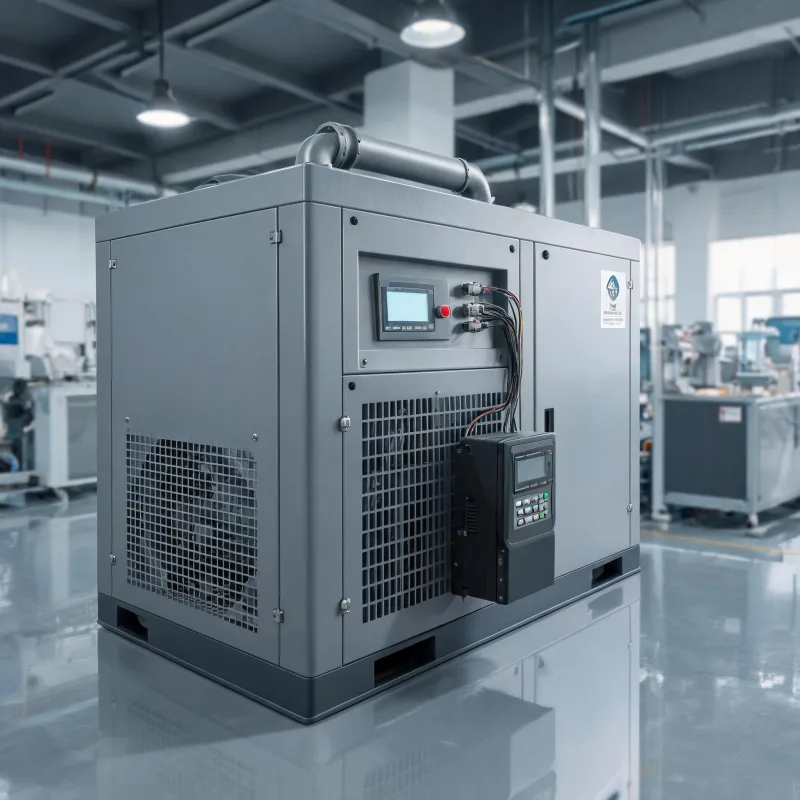
Mount the variable frequency drive upstream of the compressor motor. Re-calibrate the system pressure control settings to match the new variable speed output. Test the full load and partial load operation to confirm pressure stability.
Most standard retrofits for 50HP to 150HP units can be completed in one 8-hour shift, with minimal production downtime.
Post-Retrofit Performance Monitoring
Schedule monthly energy use tracking for the first 6 months after installation. Compare actual energy use to projected savings to confirm performance. Adjust control parameters if your facility’s compressed air demand pattern shifts over time.
Annual leak checks and drive calibration will maintain savings levels for the full lifespan of the upgrade.
Expert Insights
This retrofit is one of the highest ROI industrial energy saving projects available today for manufacturing facilities. Skipping pre
— retrofit load testing is the most common mistake that erodes project returns.
Further Reading
- High-Efficiency Air End Replacement Retrofit for Aging Piston Compressors
- Air Compressor Post-Treatment System Energy Efficiency Retrofit Guide
- Multi-Machine Parallel Central Control Energy Saving Upgrade Scheme
- Waste Heat Recovery Retrofit Technology for Industrial Screw Air Compressors
- Frequency Conversion Retrofit Solution for Constant Speed Air Compressors, constant speed air compressor energy saving, VFD air compressor retrofit – 2024 Trends &
- Air Compressor Pipeline Leak Repair Energy Saving Transformation Plan
- VSD Permanent Magnet Motor Retrofit for Old Fixed Air Compressors
About the Author

Related Reading: Large Flow Two Stage Screw Compressor Whole Mine Air Supply Scheme
Frequently Asked Questions
How much upfront investment does this retrofit require?
For a standard 100HP constant speed air compressor, total cost including parts and labor ranges from $7,000 to $12,000, depending on facility conditions.
Will the retrofit shorten my air compressor’s service life?
When installed correctly, reduced motor starting current and smoother operation actually extend unit service life by 3-5 years on average.
Do I need to replace my existing motor for this retrofit?
Most modern constant speed compressor motors are compatible with VFDs. Only older motors with low voltage insulation need replacement.
Are there government incentives for this energy saving upgrade?
Most U.S. states and utility companies offer rebates covering 10-30% of total project cost, per DSIRE 2024 data.
How long does it take to complete the installation?
Most standard retrofits are finished within one 8-hour work shift, with minimal production downtime.
How do I confirm if my unit is eligible?
If your unit runs at partial load for more than 4 hours daily and is in good working condition, it is almost always eligible.