Training Brief: CFM Sizing for Diesel Air Compressors on Large Construction Sites
Required CFM equals sum of peak demand plus 10-20% safety buffer for large construction sites.
Key Takeaways
- Sum only CFM demand for simultaneously running tools in a single work zone
- Adjust CFM requirement for elevation and temperature before adding safety buffer
- Add 10-20% safety buffer aligned with ISO 12100-2010 requirements
- Over-sizing wastes thousands of dollars in excess fuel every month
Related: calculate required CFM · large site operation · construction air supply · CFM for diesel compressors · site air demand · air compressor sizing
Last summer we worked a 120-acre highway project outside Denver, 5200 feet elevation, 95°F ambient temperature, six breakers and two sandblasters running nonstop. The wrong CFM rating cut output 18% before we adjusted.
Learning Objectives
By the end of this session, you will be able to: Sum peak air demand for all simultaneous tools on your site segment Adjust CFM requirements for elevation and ambient temperature Add the correct safety buffer without over-sizing Spot mis-sizing that wastes fuel or causes downtime
That’s all we need today, no extra theory.
Key Action Verbs
Site foreman: Pull the full tool list for your active work zone before any equipment is moved in. Equipment lead: Check the rated CFM consumption of every tool that will run at the same time. No one skips the elevation adjustment. High altitude reduces air density, so you add 3% CFM per 1000 feet above sea level. Hot ambient temperatures above 80°F require an extra 2% CFM adjustment for every 10°F over the mark. Always add a 10 to 20% safety buffer after you finish the base calculation.
Demonstration Key Points
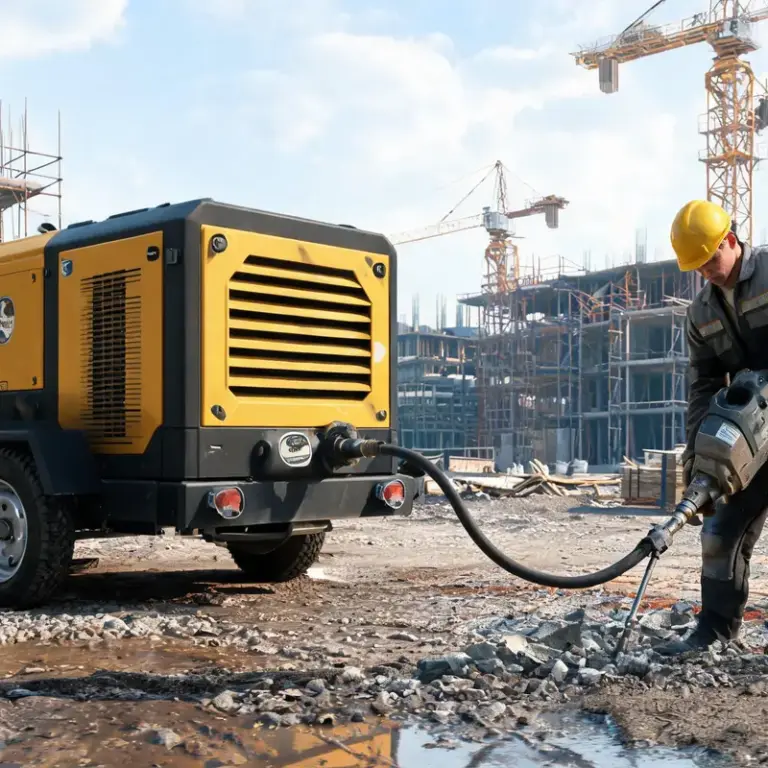
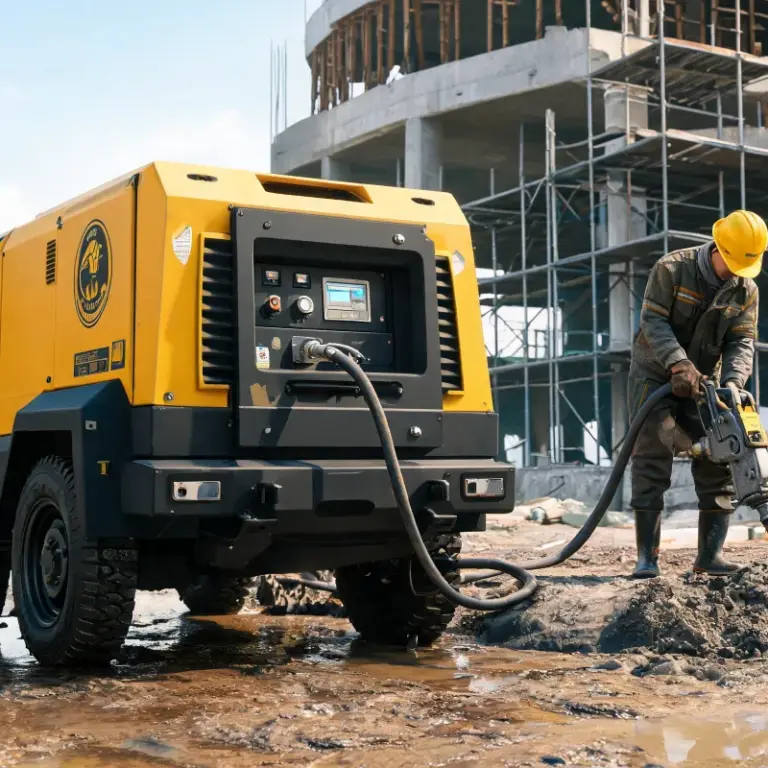
Take a 10-acre commercial building foundation site as an example. Active simultaneous tools: 3 jackhammers (95 CFM each), 2 concrete breakers (110 CFM each), 1 bulk air line for power tools (40 CFM base load). Base sum: (3*95)+(2*110)+40 = 285 + 220 +40 = 545 CFM. Site sits at 3000 feet elevation: add 9% = 545 * 1.09 = 594 CFM. Ambient temperature average 90°F: add 2% = 594 * 1.02 = 606 CFM. Add 15% safety buffer for unexpected tool changes: 606 * 1.15 = ~700 CFM. That’s the minimum rating you need.
ISO 12100-2010 requires the safety buffer to account for unplanned simultaneous operation, so this step is not optional. OSHA 2020 construction equipment guidelines also note that under-sized air supply increases tool wear and safety risks.
Common Misoperations
Don’t add the safety buffer before making temperature and elevation adjustments. This skews the final number by 5 to 10% unnecessarily. Don’t size for all tools on the entire site, only for tools that run simultaneously in the same work zone. If you have two separate work zones ½ mile apart, you size separately for each. Never size for maximum CFM across the whole site to “cover everything”. This forces you to run a unit that’s 30% larger than needed, wasting thousands of dollars in extra fuel every month. If your site has intermittent use of high-demand tools, don’t size for the peak intermittent tool alone. Shift operation schedules to run high-demand tools one at a time to reduce the required CFM.
Assessment Criteria
Passing grade requires three correct steps: 1. Correctly identifies only simultaneous running tools for the work zone 2. Applies correct adjustment factors for elevation and ambient temperature 3. Adds the correct safety buffer to get the final minimum CFM
Anyone who fails the practice calculation will re-do the exercise after this session until they get it right. Wrong sizing leads to unplanned downtime that costs more than the extra half hour of training today.
Implementation Checklist
- Pull full tool list for your active work zone
- Count only tools that will run simultaneously
- Calculate base total CFM of all selected tools
- Apply elevation adjustment (3% per 1000ft above sea level)
- Apply temperature adjustment (2% per 10°F over 80°F)
- Add 10-20% safety buffer based on work scope stability
- Confirm final CFM requirement with site foreman
Pitfalls to Avoid
- Do not size for all tools across the entire construction site
- Do not add safety buffer before making elevation and temperature adjustments
- Do not ignore elevation adjustments for high-altitude work sites
- Do not over-size just to cover unlikely peak demand scenarios
Glossary
- CFM: Cubic Feet per Minute, measure of compressed air flow volume
- Safety buffer: Extra CFM added to cover unplanned demand
- Peak demand: Maximum simultaneous air flow required for a work zone
Further Reading
- # Diesel Portable Air Compressor for Construction Site Compressed Air Supply
- Diesel Powered Portable Compressors For Construction Site Compressed Air Drying
- Towable vs Wheeled Diesel Portable Air Compressors for Construction Job Sites
- Low Fuel Consumption Mobile Diesel Air Compressor for Construction Sites
- How to Accurately Calculate Required CFM for Diesel Air Compressors for Industrial Sites
- High CFM Low Emission Diesel Portable Air Compressor for Commercial Job Sites
- How to Select a Diesel Portable Air Compressor for Road Construction Work Sites
- Diesel Portable Air Compressor Meeting Class Zero Oil-Free Needs for Construction Sites
About the Editorial Team
Related Reading: 2024 CFM Calculation Best Practices for Sizing Diesel Driven Air Compression Units
Frequently Asked Questions
What happens if I pick a CFM rating lower than required?
Tools run slower, wear out faster, and may stop entirely during peak demand.
Do I need to adjust CFM for cold weather?
Cold air is denser, so you could subtract a small buffer, but keep 10% safety margin to avoid issues.
Does CFM requirement change with different pressure settings?
Most tools are rated for 90 PSI, so match CFM to the operating pressure your tools require.
Can I share a single unit across multiple work zones?
Only if work zones never run tools at the same time. Otherwise size each zone separately.
What safety buffer should I use for a stable work zone?
10% is enough for fixed, stable tool sets. Use 20% for sites with frequent tool changes.