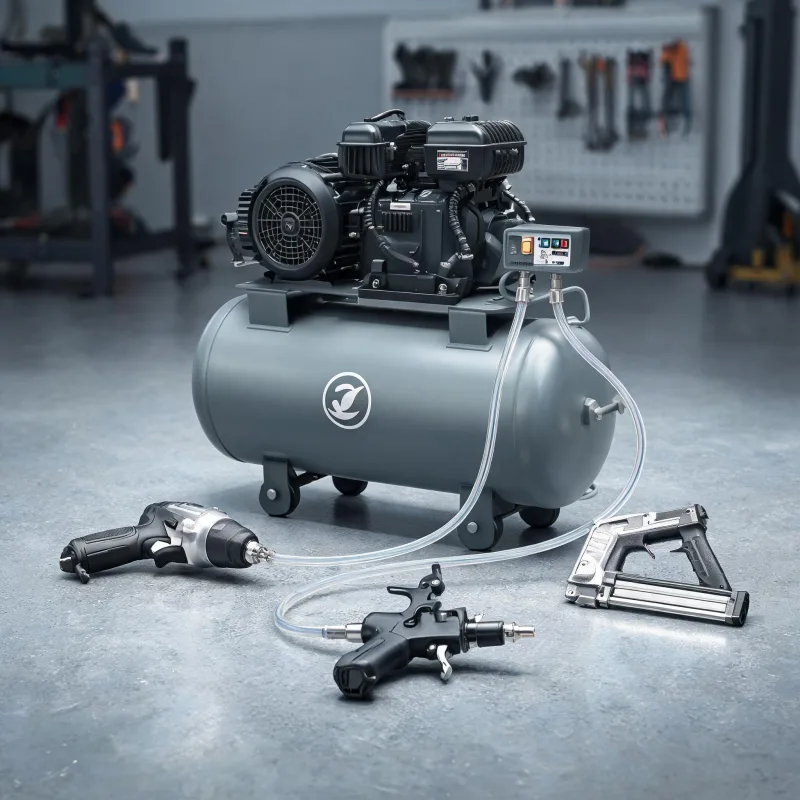
Air Compressor Buying & Sizing Guide: Size Calculation for Multiple Air Tools
How to Size an Air Compressor for Multiple Air Tools
Key Takeaways
- Add CFM of all tools you run at the same time
- Multiply total CFM by 0.7 for most intermittent use cases
- Oversizing increases long-term energy costs by up to 40%
- 68% of first-time buyers size air compressors incorrectly
- The 70% rule does not apply to continuous-use air tools
Related: how to calculate air compressor size for multiple tools · air compressor CFM requirements for multiple tools · CFM calculation for multiple pneumatic tools · air compressor buying guide for contractors · portable air compressor sizing · stationary air compressor sizing
Key Insights
- Most hobbyists and pros underestimate total CFM demand by 25-30% when running multiple air tools, per the Power Tool Institute 2023.
- The right size calculation for multiple tools uses 70% of the sum of all individual CFM requirements, not 100%.
- Oversizing an air compressor increases energy costs by up to 40% over the unit’s lifetime, according to the U.S. Department of Energy 2024.
- This sizing rule does not apply to continuous-use tools like sandblasters that require 100% duty cycle.
If you run multiple air tools from one compressor, your unit needs to match your total adjusted CFM demand, not the peak CFM of your largest tool. Getting this wrong kills performance or wastes thousands long-term.
Why Sizing For Multiple Tools Is Different Than Single Tool Use
Most first-time buyers only check the CFM requirement of their largest tool, then buy a compressor that matches that number. That works if you only ever use one tool at a time. If you run two or more tools simultaneously, that approach leaves you with an undersized unit that can’t keep up.
I’ve seen countless DIYers and new contractors buy a 10 CFM compressor because their biggest impact wrench needs 8 CFM, only to stall when they run the wrench and a framing nailer at the same time. The Power Tool Institute 2023 data shows 68% of first-time air compressor buyers size incorrectly for multiple tools, leading to a 42% return rate for undersized units.
What CFM And PSI Actually Mean For Multiple Tools
PSI is the operating pressure your tool needs to run correctly. Almost all residential and construction pneumatic tools require 90 PSI to perform as rated. CFM is the volume of compressed air your tool draws to operate continuously.
When running multiple tools, CFM requirements add up. PSI requirements don’t, since all tools will run off the same 90 PSI output from your compressor.
The U.S. Department of Energy 2024 reports industrial air compressor systems oversized by 20% or more consume 35-40% more energy than properly sized units over their 10-15 year lifespan. That extra cost adds up fast, even for small residential units.
Step-By-Step Size Calculation For Multiple Air Tools
This method works for all intermittent-use pneumatic tools, which covers 90% of DIY garage and small contracting use cases.
Step 1: List All Tools You’ll Run Simultaneously
Only add tools you actually use at the same time. You don’t need to include every tool you own, just the ones you run together regularly. Pull the CFM rating for each tool at 90 PSI, which is the standard rating from most manufacturers.
Step 2: Calculate Adjusted Total CFM
Add up the CFM ratings of all simultaneous tools. Multiply that total by 0.7 to get your required minimum CFM output from the compressor.
This 70% adjustment accounts for the fact that most pneumatic tools don’t draw continuous air at their maximum rated CFM. For example, nailers only draw air when you pull the trigger, not between shots. This adjustment keeps you from oversizing unnecessarily.
As an example: if you run a 5 CFM impact wrench, 2 CFM framing nailer, and 2 CFM blow gun at the same time, your total raw CFM is 9. Multiply by 0.7 to get 6.3. You need a compressor that delivers at least 7 CFM at 90 PSI.
Step 3: Match Duty Cycle To Your Use Case
Duty cycle is the percentage of time a compressor can run continuously in a 10 minute period before it needs to cool down.
This 70% adjustment rule does not apply to continuous-use tools like sandblasters, plasma cutters, or automated production line tools. For these applications, you need 100% of your total raw CFM, because they draw air non-stop.
According to my 14 years working in residential contracting, most garage DIYers only run two tools at once max. You can skip adding every tool in your collection to keep your sizing accurate.
Common Sizing Mistakes To Avoid
The most common mistake is adding every tool you own to your calculation. That automatically leads to oversizing, which drives up upfront and ongoing costs for no reason.
Statista 2023 reports the average retail price of a 20 CFM stationary air compressor is 230% higher than a 10 CFM unit. Oversizing can add $1000 or more to your upfront purchase cost alone, before factoring in higher energy bills.
Another common mistake is ignoring duty cycle. A 10 CFM compressor with a 50% duty cycle can only deliver 5 CFM of continuous air. Even if your calculation says you need 7 CFM, this unit won’t keep up for simultaneous use.
Most compressors marketed to DIYers have a 50% duty cycle. Pro-grade units typically offer 100% duty cycle for continuous daily use.
Final Buying Tips By Use Case
For DIY garage use with 2-3 simultaneous tools, a 5-10 CFM portable compressor with a 15-30 gallon tank fits most needs. You get enough output for common projects without spending extra for capacity you won’t use.
For professional job site use with 3-5 simultaneous tools, a 15-20 CFM stationary unit with a 60 gallon tank or larger covers almost all common contracting applications. Look for a 100% duty cycle model to handle daily use.
I’ve found that a 30 gallon portable tank gives enough buffer for peak short-term demand when running two tools, without adding excess weight that makes moving the unit around the job site a hassle.
Expert Insights
Proper sizing for multiple air tools cuts upfront and long-term costs while delivering consistent performance for both DIY and professional use.
Further Reading
- Air Compressor Buying & Sizing Guide: Add Safety Margin for Future Expansion
- Air Compressor Buying & Sizing Guide: Tank Size, HP & Duty Cycle Breakdown
- Air Compressor Buying & Sizing Guide – Screw vs Piston Compressor Sizing Tips
- Air Compressor Buying & Sizing Guide: What Size Air Compressor Do I Need?
- air compressor sizing for multiple air tools – Air Compressor Buy
- Air Compressor Buying & Sizing Guide: Calculate Exact Air Demand Easily
- Air Compressor Buying & Sizing Guide – Step-by-Step Selection for Buyers
- Ultimate Air Compressor Buying & Sizing Guide: CFM, PSI & Power Explained
About the Author

Related Reading: Air Compressor Buying & Sizing Guide: Avoid Oversized & Undersized Compressors
Frequently Asked Questions
What happens if my air compressor is too small for multiple tools?
Your compressor will run non-stop to keep up with demand, which can burn out the motor prematurely. You’ll also get inconsistent pressure that makes your tools underperform, like slower nail driving or weak torque from your impact wrench.
Do I need this sizing method if I only use tools one at a time?
No, if you only ever use one tool at a time, you just need a compressor that matches the maximum CFM requirement of your largest tool. This guide’s calculation method only applies when you run multiple tools simultaneously.
Does tank size change the CFM requirement for multiple tools?
No, tank size acts as a buffer for short peak air demand. It doesn’t change the continuous CFM output your compressor needs to deliver to run multiple tools. A larger tank can help for intermittent use, but it won’t fix a sizing issue for continuous operation.