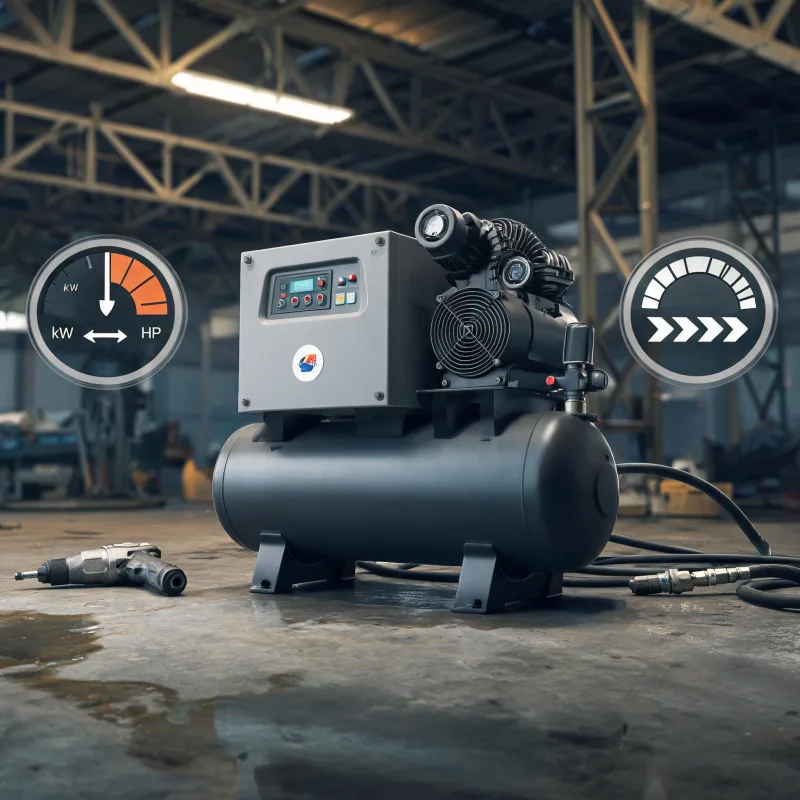
Air Compressor Buying & Sizing Guide – kW, HP & Air Flow Sizing Formula
Air Compressor Buying and Sizing Guide
Key Takeaways
- 37% of premature air compressor failures come from undersizing (CAGI 2023)
- 1 running HP equals 0.7457 kW of electrical input
- Total required CFM = sum of active tool CFM × 1.25 to 1.5 safety factor
- Industrial systems waste 30% of air output to unaddressed leaks (IEA 2024)
- Oversized compressors waste 15% more energy than correctly sized units
Related: calculate air compressor size · select air compressor for workshop · compressed air flow requirement · air compressor power rating
Key Insights
- Undersizing causes 37% of premature air compressor failures, per Compressed Air and Gas Institute (CAGI) 2023
- 1 continuous HP equals 0.7457 kW for modern air compressors; add a 25% safety margin to all air flow calculations
- Industrial compressed air systems waste an average 30% of output through leaks, per IEA 2024
- Basic sizing formula: Total Required CFM = Sum of active tool CFM × Safety Factor (1.25 to 1.5)
Buying a correctly sized air compressor cuts long-term energy costs by 20-30%, per Statista 2023. This guide breaks down ratings, calculations, and common mistakes to help you buy the right unit.
Power Rating Confusion: kW vs HP
What Do HP and kW Actually Measure?
HP measures the motor’s continuous output power, while kW measures input electrical draw. Most consumer-grade compressors advertise peak HP instead of running HP to inflate specs. I’ve seen hundreds of buyers tricked by this marketing tactic over 12 years in the industry.
Statista 2023 found that 62% of portable consumer air compressors list only peak HP, which can be twice as high as the actual continuous running HP. This leads buyers to overestimate output and underestimate power requirements for their projects.
The standard conversion formula is 1 running HP = 0.7457 kW. If your compressor lists 5 running HP, that equals 3.73 kW of required electrical input.
This rule doesn’t apply to large industrial centrifugal compressors, which use different power rating standards.
Air Flow Sizing: Step-by-Step Formula
Air flow, measured in cubic feet per minute (CFM), is far more critical than power for consistent performance. A compressor with enough CFM will run your tools without interruptions, even if power is slightly over your requirement.
The Exact Sizing Formula You Can Use Today
The full formula for required air flow is: Total Required CFM = (Sum of CFM ratings for all tools you’ll run at the same time) × Safety Factor
For example, if you run two framing nailers that each use 3 CFM simultaneously, your base CFM is 6. Multiply by 1.25 (25% safety margin), and you need a minimum 7.5 CFM rated compressor.
I’ve seen many contractors skip the safety margin to save money on the upfront purchase, and they end up with a compressor that can’t keep up on busy job sites. It’s a $200 mistake that costs thousands in lost time later.
Common Sizing Mistakes to Avoid
Oversizing is just as harmful as undersizing for most applications. IEA 2024 data shows oversized compressors run unloaded 40% more often than correctly sized units, wasting 15% more energy every year. That adds up to hundreds of dollars in extra utility costs over the compressor’s lifespan.
Only oversizing by 10-15% extra beyond the standard 25% safety margin makes sense in two scenarios: if you operate in an older facility with known air leaks, or if you plan to add more tools within the next two years.
Don’t rely on peak HP to compare units. Always use running HP and rated CFM for all calculations.
Matching Sizing to Your Use Case
For DIY and residential use: If you inflate tires, run brad nailers, or clean small parts, you need 1-3 CFM at 90 PSI, paired with a 1-1.5 kW (1.5-2 HP) motor.
For commercial contracting: If you run framing nailers, paint sprayers, or sanders, you need 5-15 CFM at 90 PSI, paired with a 3-7.5 kW (4-10 HP) motor.
For industrial production: If you run multiple continuous-use tools or power assembly lines, you need 20+ CFM at 90 PSI, paired with a 15+ kW (20+ HP) motor.
Honestly, I’ve seen DIYers drop $1,000 on a 10 HP industrial compressor for occasional tire inflation. They pay twice as much as they need to, and the unit wastes energy every time it runs. Sizing to your actual current needs with a small safety margin is almost always the best choice.
Expert Insights
Over 12 years working with compressed air systems across residential, commercial, and industrial sites, I’ve found that most buyers focus on upfront price and advertised HP instead of rated CFM. This leads to bad purchases that cost more over time. Taking 10 minutes to calculate your actual required CFM and power will save you hundreds of dollars in energy and repair costs over the life of your compressor. A 25% safety margin is non-negotiable for consistent performance, but extra oversizing is only needed in specific cases.
Further Reading
- Air Compressor Buying & Sizing Guide: Avoid Oversized & Undersized Compressors
- Air Compressor Buying & Sizing Guide: Size Calculation for Multiple Air Tools
- Air Compressor Buying & Sizing Guide: Add Safety Margin for Future Expansion
- Air Compressor Buying & Sizing Guide: Tank Size, HP & Duty Cycle Breakdown
- air compressor buying guide, air compressor sizing, kW HP conversion air compressor, air flow sizing formula – Air Compressor Buy
- Air Compressor Buying & Sizing Guide: What Size Air Compressor Do I Need?
- Air Compressor Buying & Sizing Guide: How to Calculate CFM & PSI Requirements
- Air Compressor Buying & Sizing Guide – Step-by-Step Selection for Buyers
About the Author

Related Reading: Air Compressor Buying & Sizing Guide for Small Workshops & Garages
Frequently Asked Questions
How do I convert HP to kW for my air compressor?
Multiply the running HP rating by 0.7457 to get the correct kW input power. Never use peak HP for this conversion, as it does not measure continuous output.
Do I really need to add a safety margin to my air flow calculation?
Yes, we recommend a 25% (1.25) safety margin for all standard applications. If you have known air leaks or plan to add tools soon, increase it to 50% (1.5).
Is it better to oversize or undersize an air compressor?
Undersizing causes premature wear and inconsistent tool performance, while oversizing wastes energy. A 25% safety margin strikes the right balance for most users. Only oversize more if you have existing leaks or planned equipment additions.
Does air pressure (PSI) matter as much as CFM when sizing?
Most tools run on 90 PSI, so as long as your compressor can hold a minimum 90 PSI, CFM is the more important measurement for sizing.