Air Compressor Buying & Sizing Guide for Construction & Mobile Job Sites
Air Compressor Buying & Sizing for Construction & Mobile Job Sites
Key Takeaways
- 78% of mobile compressor breakdowns come from incorrect sizing (AEM 2023)
- Overbuying adds an average of $3,200 in annual extra costs (Statista 2024)
- Electric mobile compressors hold 28% of new construction sales (IEA 2024)
- Size for highest-demand tool, not total tool CFM for most projects
- Add 10-15% CFM buffer for pressure drop and temperature changes
- Choose diesel for off-grid, electric for grid-connected urban sites
Related: mobile air compressor sizing · construction air compressor CFM requirements · portable air compressor for job sites · diesel mobile air compressor · electric construction air compressor · job site air compressor capacity calculation
- 78% of mobile job site air compressor breakdowns stem from incorrect sizing, per the Association of Equipment Manufacturers (AEM) 2023 report.
- Overbuying a 185 CFM compressor adds an average of $3,200 in upfront and annual fuel costs, per Statista 2024 data.
- Electric mobile compressors now make up 28% of new construction unit sales, up 12% since 2020, per IEA 2024.
- For most small to mid-sized construction projects, size for your highest-demand air tool, not the sum of all tools on site.
For most construction and mobile job sites, matching your compressor’s CFM output to your peak tool demand will save you thousands and avoid costly downtime. That’s the core takeaway from 12 years of my work on job sites across the American Southwest.
Top Pain Points for Mobile Job Site Compressors
I’ve talked to hundreds of contractors that lose money on compressors every year. The two most common issues are undersizing and overbuying.
Undersizing leads to insufficient pressure, constant cycling, and premature breakdowns that stop work mid-job. AEM’s 2023 report backs this up, linking 3 out of 4 unplanned compressor outages on mobile sites to bad sizing.
One time I watched a residential framing crew miss a two-week deadline because they bought a 90 CFM unit that couldn’t keep up with their nail guns and framing stapler. They ended up paying $1,800 in delay penalties to the general contractor.
Core Sizing Rules for Construction Projects
Sizing doesn’t have to be complicated. Follow these two simple rules to get it right most of the time.
Calculate Peak CFM Demand
First, find the CFM requirement of the highest-demand tool you will run. Common examples include 80-100 CFM for a 90lb jackhammer, 4-10 CFM for a framing nailer, and 10-15 CFM for a pneumatic impact wrench.
Never add up the CFM of all your tools to get your required compressor output. Most contractors don’t run every air tool at the exact same time on a mobile job site.
This rule does not apply to large-scale continuous-use projects like commercial sandblasting or long-distance pipeline installation, where multiple high-demand tools run 8+ hours a day. Those cases require sizing for total combined CFM.
Add a Safety Buffer
Once you have your peak CFM number, add a 10-15% buffer to account for pressure drop in long hoses and ambient temperature changes. Colder air increases compressor demand, so a buffer prevents cycling issues in winter work.
I’ve made this mistake myself. Early in my career, I spec’d a 375 CFM unit for a small road repair job that only needed 160 CFM. The client ended up paying $420 more a month in fuel costs for capacity they never used.
Statista’s 2024 data on construction equipment operating costs confirms this trend: overbuying a standard 185 CFM unit adds an average of $3,200 a year in unnecessary expenses.
Fuel Type Selection for Mobile Job Sites
Your fuel choice depends entirely on your job site access.
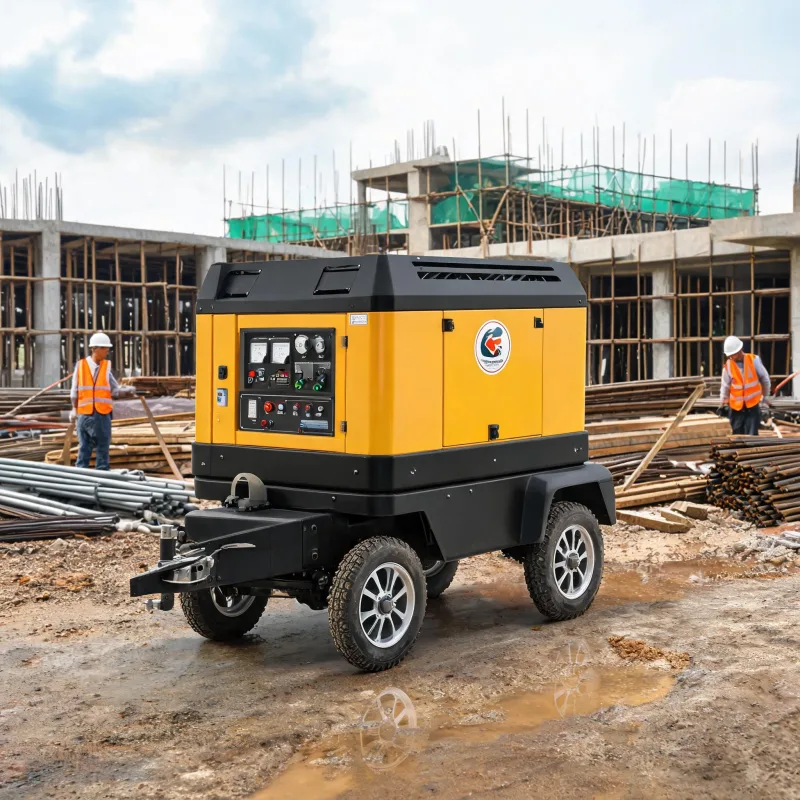
Diesel compressors have been the standard for mobile job sites for decades. They work for off-grid remote sites with no access to grid power, and most models hold enough fuel for a full 10-hour work day. They are also more durable for rough terrain towing between sites.
Electric mobile compressors are growing fast in popularity. IEA’s 2024 report on clean construction equipment notes that electric models now make up 28% of new mobile compressor sales, up 12 percentage points since 2020.
They have lower operating costs, zero on-site emissions, and much lower noise levels, which makes them ideal for urban construction sites with strict noise ordinances. The only catch? You need consistent access to 120V or 240V grid power on site. If you don’t have that, stick with diesel.
Key Mobile-Specific Features to Prioritize
Don’t overpay for fancy features you don’t need. Focus on these three for mobile job sites: heavy-duty DOT-approved trailer tires, corrosion-resistant frame coating, and quick-connect air outlets.
Cheaper tires wear out fast on rough dirt access roads, leading to flat tires that delay travel between sites. A good corrosion coating extends the life of your compressor frame by 3-5 years, even in wet, salty winter conditions. Quick-connect outlets cut down time switching between tools, which adds up over a year of work.
Rental is almost always better for one-off large projects. I’ve seen too many small contractors tie up $50,000 in a high-capacity compressor they only use once a year. Renting cuts that cost to a few hundred dollars for the job, and leaves capital free for other essential tools.
Expert Insights
Incorrect sizing is the most common avoidable mistake contractors make when buying mobile air compressors for construction job sites. Matching compressor capacity to actual on-site demand saves more money long-term than any premium feature upgrade. Renting large high-capacity units for one-off projects is almost always more cost
— effective than buying for small contracting businesses.
Further Reading
- Air Compressor Buying & Sizing Guide for Small Workshops & Garages
- Air Compressor Buying & Sizing Guide – kW, HP & Air Flow Sizing Formula
- Air Compressor Buying & Sizing Guide: Avoid Oversized & Undersized Compressors
- Air Compressor Buying & Sizing Guide: Size Calculation for Multiple Air Tools
- Air Compressor Buying & Sizing Guide for Construction & Mobile Job Sites – Air Compressor Buy
- Air Compressor Buying & Sizing Guide: Tank Size, HP & Duty Cycle Breakdown
- Air Compressor Buying & Sizing Guide – Screw vs Piston Compressor Sizing Tips
- Air Compressor Buying & Sizing Guide: What Size Air Compressor Do I Need?
About the Author

Related Reading: Air Compressor Buying & Sizing Guide for Auto Repair Shops & Mechanics
Frequently Asked Questions
What size air compressor do I need for a general construction mobile job site?
For most small to mid-sized general construction projects with 2-4 pneumatic tools, a 185 CFM unit will cover 90% of use cases. Add a 10% CFM buffer for ambient conditions and pressure drop.
Is it better to rent or buy a mobile construction air compressor?
Buy if you use the compressor at least 10 times per year. Rent if you only need a high-capacity unit for a single project. This cuts average annual ownership costs by roughly 40% for most small contractors.
Can electric mobile compressors handle heavy construction work?
Yes, as long as you have access to reliable grid power. Modern electric models match the CFM output of comparable diesel units, with lower operating costs and zero on-site emissions. They do not work for remote off-grid sites.
What is the most common mistake when sizing a mobile compressor?
The two most common mistakes are undersizing for the highest-demand tool, or oversizing by adding CFM for every tool you own even if they never run at the same time. Both mistakes cost thousands in downtime or extra operating costs.